
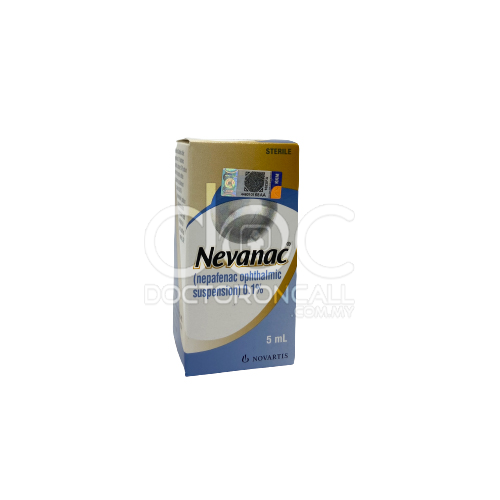
Nevanac 0.1% Eye Drop
- Fast Delivery
- Muslim-Friendly
- FDA Approved
- Secure Payment
Overview
Nevanac 0.1% Eye Drop contains nepafenac, a non-steroidal anti-inflammatory drug (NSAID) formulated as an eye drop to reduce pain and inflammation inside the eye following cataract surgery. It is most commonly prescribed to prevent and treat post-operative ocular inflammation and to help manage macular oedema risk associated with cataract surgery in certain patients, working locally in the eye rather than through the whole body.
Because Nevanac is used around the time of eye surgery and its dosing schedule needs to be tailored to the individual’s surgical timeline and eye condition, it is a prescription-only medicine in Malaysia and Singapore. Through DoctorOnCall, an online consultation with a doctor is required so your suitability, surgical history, and any other eye medications can be assessed before a prescription for Nevanac is issued and the order processed.
How it Works
Nepafenac is a prodrug that, once it penetrates the cornea, is converted by ocular tissue enzymes into amfenac, an active NSAID that inhibits cyclo-oxygenase (COX) enzymes and reduces the production of prostaglandins, the chemical messengers responsible for inflammation, pain, and swelling inside the eye after surgery. By lowering prostaglandin levels in the eye, Nevanac helps control post-operative inflammation and associated discomfort.
Directions for Use
Nevanac should only be used exactly as prescribed by your ophthalmologist or doctor, typically starting a day before cataract surgery and continuing for a specified number of weeks afterwards. Wash your hands, tilt your head back, gently pull down the lower eyelid, and instil one drop into the operated eye without letting the dropper touch the eye or any surface; if you use other eye drops as well, space them at least 5 minutes apart from Nevanac in the order your doctor recommends.
Dosage
The typical prescribed regimen is one drop in the affected eye three times daily, commencing the day before surgery, continued on the day of surgery, and for the first 2 weeks of the postoperative period, extending up to the first month for cataract surgery patients at risk of macular oedema, exactly as your prescribing doctor directs. Do not adjust the dose, frequency, or duration on your own, and do not stop early even if your eye feels comfortable, unless advised by your doctor.
Shelf Life
Use Nevanac before the expiry date printed on the carton and bottle. Once opened, the bottle should generally be discarded 4 weeks after first use, or sooner if advised by your pharmacist, even if solution remains in the bottle.
Storage Instructions
Store below 30°C, protected from light, and keep the bottle upright in its original carton when not in use. Do not freeze. Keep out of reach and sight of children, and dispose of any unused or expired solution responsibly.
Side Effects
- Mild stinging or burning in the eyes after application
- Blurred vision temporarily after use
- Headache
- Dry eyes or watery eyes
- Sensitivity to light
- Feeling of something in the eye
Contraindications
- Known hypersensitivity to nepafenac, other NSAIDs, aspirin, or any component of the formulation
- History of asthma, urticaria, or allergic reactions triggered by aspirin or other NSAIDs
- Known bleeding tendencies or conditions that may prolong bleeding time
- Pre-existing corneal disease or previous complicated ocular surgery, which may increase risk of corneal complications
- Should not be used without your doctor’s confirmation that it is appropriate alongside your specific surgical and eye-health history
Drug / Food Interactions
- Using Nevanac together with other topical NSAIDs may increase the risk of corneal problems and is generally avoided
- Combining with topical corticosteroid eye drops may further increase the risk of delayed healing; your doctor will advise if both are needed and how to space them
- Inform your doctor if you take oral anticoagulants (blood thinners) or other medicines that affect bleeding, as these may add to bleeding risk with ocular NSAID use
- No specific food interactions are known, but always disclose all eye drops and medicines you are using to your prescribing doctor
Quick Tips
- Only use Nevanac under an active prescription and follow your doctor’s exact schedule around your cataract surgery date
- Do not touch the dropper tip to your eye or any surface to avoid contamination
- Wear or use any protective eye shield as advised after surgery, and attend all follow-up appointments so healing can be monitored
- Contact your doctor immediately if you notice worsening eye pain, redness, vision loss, or unusual discharge
- Do not share your Nevanac bottle with anyone else, even if they have had similar surgery
- Keep track of your opened-bottle date and discard 4 weeks after opening
Frequently Asked Questions
What is Nevanac 0.1% Eye Drop used for?
Nevanac 0.1% Eye Drop contains nepafenac and is prescribed to reduce pain, inflammation, and swelling in the eye following cataract surgery, and to help lower the risk of macular oedema in certain post-surgical patients.
When and how often should I use Nevanac Eye Drop around my cataract surgery?
Your doctor will typically instruct you to start one drop three times daily the day before surgery, continue on the day of surgery, and keep using it for the first 2 weeks afterward, sometimes extending to the first month, exactly as prescribed.
What are the possible side effects of Nevanac Eye Drop?
Most people notice mild, temporary stinging, blurred vision, or light sensitivity right after each dose. Rarely, prolonged use may slow corneal healing or raise eye pressure, so any worsening pain or vision change should be reported to your doctor promptly.
Who should not use Nevanac 0.1% Eye Drop?
People with a known allergy to nepafenac, aspirin, or other NSAIDs, those with bleeding disorders, and patients with pre-existing corneal disease should not use Nevanac without their doctor’s specific clearance.
Do I need a prescription to use Nevanac 0.1% Eye Drop?
Yes, Nevanac is a prescription-only ophthalmic medicine because its use must be timed precisely around cataract surgery and monitored by an eye doctor, so it cannot be supplied without a valid prescription.
Can I purchase Nevanac 0.1% Eye Drop through DoctorOnCall in Malaysia or Singapore?
Yes, Nevanac 0.1% Eye Drop is available through DoctorOnCall for customers in Malaysia and Singapore, but as a prescription medicine an online consultation is required so a doctor can assess your suitability and issue a prescription before your order is processed.
Is Nevanac 0.1% Eye Drop supplied by DoctorOnCall genuine and safe to use for customers in Malaysia and Singapore?
Yes, Nevanac supplied by DoctorOnCall is sourced through licensed pharmaceutical supply channels and is dispensed and checked by a registered pharmacist, giving customers in Malaysia and Singapore assurance of its authenticity and safety.
What payment methods can I use to pay for Nevanac 0.1% Eye Drop in Malaysia and Singapore?
You can pay for your Nevanac 0.1% Eye Drop order using Online Banking, Credit Card, and e-Wallets (Boost, GrabPay), along with other payment options available at checkout.
Does DoctorOnCall offer an installment payment plan for Nevanac 0.1% Eye Drop in Malaysia?
Instalment payment plans may be available for eligible purchases, subject to the payment provider’s terms; please contact DoctorOnCall Customer Service for the latest information on installment options for this product.
Is delivery free, and how much does it cost for Nevanac 0.1% Eye Drop orders to Malaysia and Singapore?
Delivery fees for Nevanac 0.1% Eye Drop depend on your delivery location, order value, and current promotions; please contact DoctorOnCall Customer Service for up-to-date shipping fee information.
How long will it take for my Nevanac 0.1% Eye Drop order to arrive in Malaysia or Singapore?
Orders for Nevanac 0.1% Eye Drop typically arrive within 3-5 working days for delivery within Malaysia, and within 5-9 working days for delivery to Singapore, though this may vary depending on location and courier conditions.
What is DoctorOnCall’s shipping, return, or cancellation policy for Nevanac 0.1% Eye Drop in Malaysia and Singapore?
Shipping, returns, and cancellations for Nevanac 0.1% Eye Drop are governed by DoctorOnCall’s Shipping & Delivery Policy and Return, Refund & Exchange Policy; please refer to these policies or contact Customer Service for guidance specific to your order.
Ingredients / Active Ingredients
- Nepafenac 0.1% w/v (active ingredient)
- Benzalkonium chloride (preservative)
- Carbomer or similar suspending agent
- Mannitol and other tonicity/buffering agents
- Purified water as the vehicle base
Safety Advice
Pregnancy
This medicine should only be used during pregnancy if prescribed by a doctor after careful evaluation.
Breastfeeding
Limited data on excretion in breast milk. Consult a doctor before use.
Kidney
Generally safe, but caution may be required in some patients.
Liver
Generally safe, but caution may be required in some patients.
Alcohol
Limited data is available regarding the effects of alcohol with this medicine.
Driving
Use caution while driving until you know how this medicine affects you.
Relevant Information
Nevanac is intended to be used as part of a structured post-cataract-surgery care plan directed by your ophthalmologist, not as a general-purpose eye drop for everyday eye discomfort. Since it is an NSAID, it carries a small risk of slowing corneal healing, so your doctor may schedule regular follow-up visits to check your eye’s recovery, particularly if you use it for an extended period or have other risk factors such as diabetes or pre-existing corneal conditions. Always complete the full prescribed course and return for scheduled reviews even if your eye appears to be healing well.
Medical Review