
Hair Loss Treatment in Malaysia: Finasteride, Minoxidil & Side Effects to Know
Introduction
Male pattern hair loss is treatable, and the two medicines with the strongest evidence, finasteride and minoxidil, are both available in Malaysia. Most men notice it first as a receding hairline or a thinning crown, often starting in their 20s or 30s.
The earlier treatment starts, the more hair it can protect. Both medicines work best at holding on to existing hair, so waiting until a large area is bald reduces what they can achieve.
This guide explains what causes male pattern baldness, how finasteride and minoxidil work, the side effects to know before starting, including NPRA’s 2025 safety alert on finasteride, and when hair loss needs a doctor’s assessment.
What is male pattern baldness?
Male pattern baldness, or androgenetic alopecia, is the most common cause of hair loss in men. It is driven by genetics and a hormone called dihydrotestosterone (DHT).
DHT is made from testosterone by an enzyme called 5-alpha reductase. In men who are genetically sensitive, DHT gradually shrinks hair follicles on the top and front of the scalp. Each new hair grows back thinner and shorter, until the follicle stops producing visible hair.
The hair at the back and sides of the head is usually resistant to DHT, which is why the pattern is so recognisable. Doctors often describe its progress using the Norwood scale:
- Early stages (Norwood 2 to 3): the hairline recedes at the temples, forming an M shape
- Middle stages (Norwood 3 vertex to 4): thinning appears at the crown as the hairline continues to recede
- Advanced stages (Norwood 5 to 7): the front and crown areas merge, leaving a horseshoe of hair at the sides and back
The condition is progressive. Without treatment, hair loss usually continues, although the speed varies from person to person.
Other causes of hair loss
Not all hair loss is male pattern baldness, and finasteride and minoxidil will not fix every type. A doctor will usually rule out these causes first:
| Cause | What it looks like |
|---|---|
| Telogen effluvium | Diffuse shedding across the whole scalp, often 2 to 3 months after illness, fever, surgery, crash dieting or major stress |
| Alopecia areata | Smooth, round bald patches that appear suddenly, sometimes in the beard or eyebrows |
| Thyroid conditions | Thinning hair alongside tiredness, weight change or feeling unusually hot or cold |
| Iron deficiency | Diffuse thinning, often with fatigue or pale skin |
| Scalp infection (tinea capitis) | Scaly, itchy or inflamed patches with broken hairs |
| Traction alopecia | Thinning along the hairline from tight hairstyles, helmets or headwear |
| Medicines | Shedding after starting certain medicines, such as some blood thinners, retinoids or chemotherapy |
Some of these conditions are reversible once the cause is treated. This is why a proper assessment matters before committing to long-term treatment.
Hair loss treatment options in Malaysia
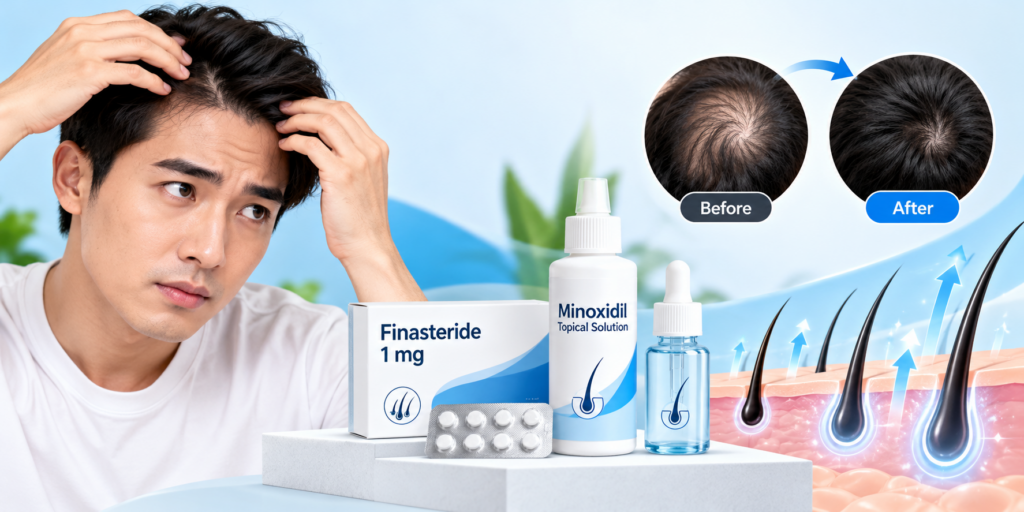
Finasteride and minoxidil are the two first-line medicines for male pattern baldness. They work in different ways, which is why doctors often recommend using them together.
| Finasteride | Minoxidil | |
|---|---|---|
| How it works | Blocks 5-alpha reductase, lowering DHT levels | Widens blood vessels and prolongs the hair growth phase |
| Form | 1 mg tablet, once daily | Topical solution or foam applied to the scalp; low-dose tablets are sometimes prescribed off-label |
| Availability in Malaysia | Prescription only | Topical forms available from pharmacies |
| Best for | Slowing or stopping further loss at the crown and mid-scalp | Thickening existing hair, especially at the crown |
| When results show | 3 to 6 months; full assessment at 12 months | 3 to 6 months; initial shedding is common in the first 2 to 8 weeks |
| If you stop | Gains are usually lost within about 12 months | Gains are usually lost within a few months |
| Suitable for women | No | Yes, at the strength advised by a doctor or pharmacist |
Finasteride
Finasteride is an oral medicine that lowers DHT, the hormone that shrinks hair follicles. Studies show it stops further hair loss in most men and regrows some hair in many of them.
In Malaysia, finasteride 1 mg is a prescription medicine, so a doctor must assess you before it can be supplied. Brands include Propecia, the original, and Finapecia, a generic version with the same active ingredient. Read more in our guides to Propecia and Finapecia.
Finasteride must not be taken by women, and women who are pregnant or may become pregnant should not handle crushed or broken tablets.
Minoxidil
Minoxidil is applied directly to the scalp, usually once or twice a day. It does not affect hormones, so it can be used by both men and women.
Most men use the 5% strength. Evidence is strongest for the crown, and results at the front hairline tend to be more modest. See our minoxidil page for available options.
Using both together
Combining finasteride and minoxidil generally gives better results than either alone. Finasteride addresses the hormonal cause while minoxidil supports regrowth. Your doctor will advise whether combination treatment suits you.
Other options
- Hair transplant: moves DHT-resistant follicles from the back of the scalp to thinning areas; usually combined with medicine to protect remaining hair
- Platelet-rich plasma (PRP): injections of your own concentrated platelets; evidence is still developing
- Low-level laser therapy: devices used at home or in clinic; modest evidence as an add-on treatment
Finasteride side effects
Most men take finasteride without problems, but side effects can occur and some need prompt medical attention. Knowing them before you start helps you spot changes early.
Common and less common side effects
- Sexual side effects: reduced sex drive, difficulty getting or keeping an erection, and a lower volume of ejaculate; reported in a small percentage of men in clinical trials
- Breast changes: tenderness or enlargement; report any lump or nipple discharge to a doctor
- Mood changes: low mood, depression and anxiety
- Allergic reactions: rash, itching, or swelling of the lips, face or throat; seek urgent care
- Effect on PSA: finasteride lowers PSA, a blood test used to screen for prostate cancer; tell any doctor ordering a PSA test that you take it
Sexual side effects usually resolve after stopping the medicine. A small number of men report symptoms that continue after stopping. Discuss any concern with your doctor rather than stopping or continuing on your own.
NPRA’s 2025 safety alert
In 2025, Malaysia’s National Pharmaceutical Regulatory Agency (NPRA) issued a safety alert on finasteride and the risk of suicidal thoughts. It followed a European Medicines Agency review that confirmed suicidal ideation as a possible side effect of oral finasteride.
The alert advises that:
- Patients should be told about the risk of mood changes, depression and suicidal thoughts before starting treatment
- Men taking finasteride for hair loss should stop treatment and contact a doctor if they notice low mood, depression or thoughts of self-harm
- Doctors should take extra care when prescribing to men with a history of depression or other mental health conditions
This is why finasteride should only be started after a doctor’s assessment. If you or someone you know is struggling, contact the Befrienders KL helpline on 03-7627 2929, or go to the nearest emergency department.
Minoxidil side effects
Topical minoxidil mainly causes scalp-related side effects, because very little reaches the bloodstream.
- Initial shedding: extra hair fall in the first 2 to 8 weeks as weak hairs are pushed out by new growth; this is usually temporary
- Scalp irritation: itching, dryness, redness or flaking; often linked to propylene glycol in the solution, so the foam can be better tolerated
- Unwanted hair growth: fine hair on the forehead or face if the product spreads beyond the scalp
- Rare effects: dizziness, chest pain, a fast heartbeat or swelling of the hands and feet; stop using it and seek medical advice
Low-dose oral minoxidil carries a higher risk of effects on blood pressure, heart rate and body hair. It should only be used under a doctor’s supervision.
When to see a doctor
Speak to a doctor before starting finasteride, and sooner if your hair loss does not follow the typical male pattern. See a doctor if you have:
- Sudden, rapid or patchy hair loss
- Pain, itching, redness, scaling or scarring on the scalp
- Hair loss with tiredness, weight change, or other new symptoms
- Hair loss that started after a new medicine, illness or major stress
- A history of depression, anxiety or other mental health conditions
- Plans to start a family in the near future
- Hair loss as a woman, or hair loss in a teenager
A doctor will review your medical history, examine the pattern of loss and may order blood tests. If male pattern baldness is confirmed, they can recommend the treatment that suits you and monitor your progress.
Get hair loss treatment online with DoctorOnCall
You can speak to a Malaysian-registered doctor online and receive treatment without visiting a clinic.
- Consult a doctor online: describe your hair loss and medical history in a private video or chat consultation
- Get a treatment plan: if suitable, the doctor recommends treatment and issues a prescription where needed
- Receive it at home: your medicine is dispensed by a licensed pharmacy and delivered in discreet packaging
Topical minoxidil is also available from the DoctorOnCall online pharmacy, with pharmacists on hand to answer questions.
Frequently asked questions
Can I buy finasteride without a prescription in Malaysia?
No. Finasteride is a prescription medicine in Malaysia. A doctor must assess you before it can be supplied, either in person or through an online consultation.
How long does hair loss treatment take to work?
Most men see the first changes after 3 to 6 months. Doctors usually assess the full effect after 12 months of consistent use.
Is hair loss treatment permanent?
No. Finasteride and minoxidil only work while you use them. If you stop, hair loss usually returns to its previous course within months.
Can I use finasteride and minoxidil together?
Yes, many men use both, and the combination generally works better than either alone. Your doctor will advise whether it suits you.
Does minoxidil work on a receding hairline?
It can help, but evidence is strongest for the crown. Results at the front hairline are usually more modest.
Can women use finasteride?
No. Finasteride is not approved for women. Women with hair loss should speak to a doctor, who may recommend minoxidil or other treatments.
Does finasteride affect fertility?
Finasteride can reduce semen volume and, in some men, sperm quality. If you are planning to start a family, discuss this with your doctor before starting.