
Minoxidil and Finasteride: Should You Use Both for Hair Loss?
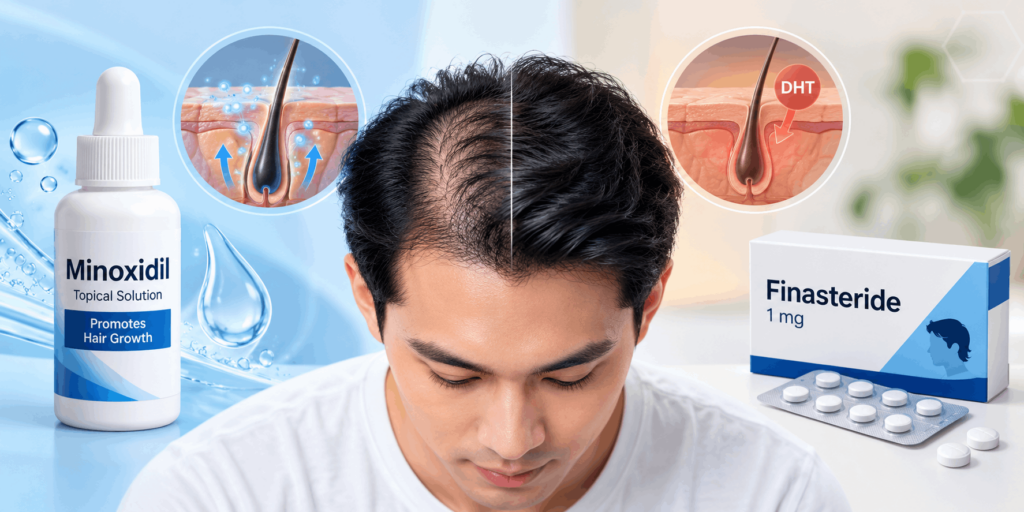
How minoxidil and finasteride work
Male pattern hair loss (androgenetic alopecia) is driven by dihydrotestosterone (DHT), a hormone made from testosterone. In men who are genetically sensitive to it, DHT gradually shrinks hair follicles. Each new hair grows back finer and shorter until the follicle stops producing visible hair.
| Finasteride | Minoxidil | |
|---|---|---|
| What it targets | The cause: DHT | The follicle: growth phase and blood flow |
| How it works | Blocks the enzyme (5-alpha reductase type II) that converts testosterone to DHT, lowering scalp DHT levels | Widens blood vessels around the follicle and extends the hair growth (anagen) phase |
| Main effect | Slows or stops further hair loss | Regrows and thickens existing hair |
| Common forms | 1 mg oral tablet; topical solution or spray | Topical solution or foam (2% or 5%) |
| Prescription needed | Yes | Topical: no, available from pharmacies |
| Who it is for | Men only | Men and women |
The key point: finasteride addresses why hair is being lost, while minoxidil works on how well the remaining follicles grow. Neither does the other’s job.
Should you use minoxidil and finasteride together?
For most men with moderate or progressing hair loss, the combination is worth considering. Clinical studies comparing combination therapy against either drug alone have generally found that men using both see more improvement in hair count and density than men on a single treatment.
The logic is straightforward. Minoxidil alone can regrow hair, but DHT keeps shrinking follicles in the background. Finasteride alone can halt the loss, but regrowth is often modest. Together, one treatment holds the line while the other rebuilds.
A single treatment may still be suitable if:
- Your hair loss is very early and you mainly want to prevent progression (finasteride alone may be enough)
- You cannot or prefer not to take finasteride (minoxidil alone still offers benefit)
- You are a woman, since oral finasteride is not suitable for women of childbearing potential
A doctor can assess the stage and pattern of your hair loss and recommend whether one or both makes sense for you.
Finasteride tablet vs topical finasteride
Finasteride is most often taken as a 1 mg tablet once a day. Topical finasteride, applied directly to the scalp as a solution or spray, is a newer option designed to act mainly where it is needed.
| Finasteride tablet | Topical finasteride | |
|---|---|---|
| How it is used | 1 mg tablet, once daily | Applied to the scalp, usually once daily |
| Where it acts | Throughout the body | Mainly the scalp, with lower levels in the blood |
| Track record | Used for hair loss since the late 1990s, with long-term data | Newer, with less long-term data |
| Side effect profile | Small risk of sexual side effects | Studies suggest lower blood DHT reduction, which may mean fewer body-wide effects |
| Convenience | One tablet, no residue | Part of a scalp routine, can be combined with minoxidil |
Topical finasteride in Malaysia
Topical finasteride is attractive for men who want the DHT-blocking effect while limiting how much of the drug reaches the rest of the body. Some formulations combine topical finasteride and minoxidil in a single solution, which simplifies the routine to one application.
Availability of topical finasteride in Malaysia can vary, and like the tablet, it requires a prescription. A DoctorOnCall doctor can advise whether a tablet or topical option suits you and what is currently available.
Minoxidil in Malaysia: which form and strength?
Topical minoxidil is available in Malaysian pharmacies without a prescription. The right choice depends on your gender, scalp sensitivity and routine.
| Option | Typical use | Good to know |
|---|---|---|
| 5% solution | Men, applied twice daily | The standard strength for male pattern hair loss |
| 5% foam | Men and women, once or twice daily depending on product | Dries faster; free of propylene glycol, so often better for sensitive scalps |
| 2% solution | Women, applied twice daily | Lower strength, less risk of unwanted facial hair |
Apply minoxidil to a dry scalp, directly on thinning areas rather than the hair itself, and wash your hands afterwards. Follow the dosing on the product label or your doctor’s instructions.
Shop minoxidil at DoctorOnCall
How to use both: routine and results timeline
The two treatments do not interact with each other, so they can be started together. A typical routine prescribed by a doctor looks like this:
- Morning: take one finasteride 1 mg tablet (with or without food), then apply minoxidil to a dry scalp.
- Evening: apply minoxidil again if using a twice-daily product. Allow it to dry before lying down.
- Every day: keep the schedule consistent. Missed days slow progress more than a late dose.
If you use topical finasteride, your doctor will advise whether to apply it at a different time from minoxidil or use a combined solution.
What to expect, month by month
- Months 1 to 2: some men notice increased shedding. This is common with minoxidil and usually means weaker hairs are being replaced by new growth. Do not stop treatment.
- Months 3 to 4: shedding settles and hair loss slows.
- Months 6 to 12: visible improvement in density and coverage for most responders. This is the point to assess results with your doctor.
- Beyond 12 months: continued use maintains results.
Both treatments only work while you use them. If you stop, hair gained or preserved is typically lost again over the following months.
Side effects and who should not use them
Most men tolerate both treatments well. Using them together does not add new side effects beyond those of each medicine.
| Finasteride | Minoxidil (topical) | |
|---|---|---|
| Possible side effects | Reduced libido, erectile difficulty or lower ejaculate volume in a small percentage of men; breast tenderness (rare) | Scalp itching, dryness or flaking; temporary shedding; unwanted facial hair; dizziness or a fast heartbeat (rare) |
| Who should avoid it | Women who are or may become pregnant should not take or handle crushed or broken tablets; men with liver problems should consult a doctor first | People with heart conditions or very low blood pressure should consult a doctor first; not for broken or irritated scalp skin |
| Good to know | Lowers PSA readings by about half, so tell your doctor if you have prostate screening | Scalp irritation is often due to propylene glycol; the foam may help |
Stop treatment and speak to a doctor if you experience persistent side effects, chest pain, a racing heartbeat, swelling, or changes in mood.
Getting minoxidil and finasteride in Malaysia
Finasteride is a prescription medicine in Malaysia. Topical minoxidil is available over the counter. To use both, you need a doctor’s assessment for finasteride, and the doctor can advise on the right minoxidil form at the same time.
With DoctorOnCall, you can:
- Consult a Malaysian-registered doctor online about your hair loss, without visiting a clinic.
- Receive a prescription for finasteride if it is suitable for you.
- Order finasteride and minoxidil from DoctorOnCall’s pharmacy with delivery to your door.
Consult a doctor about hair loss treatment ·
Frequently asked questions
Is it safe to use minoxidil and finasteride at the same time?
Yes, for most men. The two medicines work in different ways and do not interact. A doctor should confirm finasteride is suitable for you before you start.
Which is better, minoxidil or finasteride?
Neither is better overall. Finasteride is more effective at stopping hair loss, while minoxidil is more effective at regrowing hair. That is why many doctors recommend both.
Can I buy finasteride over the counter in Malaysia?
No. Finasteride requires a prescription in Malaysia. You can get one through an online doctor consultation on DoctorOnCall.
Can women use minoxidil and finasteride?
Women can use topical minoxidil, usually at 2% or 5% foam strength. Oral finasteride is not suitable for women who are or may become pregnant. Women with hair loss should consult a doctor for options.
How long before I see results?
Most men see slowed hair loss within 3 to 4 months and visible improvement within 6 to 12 months of consistent use.
What happens if I stop using them?
The benefits gradually reverse. Hair that was preserved or regrown is typically lost over the following months, returning to where it would have been without treatment.