
Minoxidil Side Effects: Shedding, Itchy Scalp & When to Stop (Plus Gentler Alternatives)
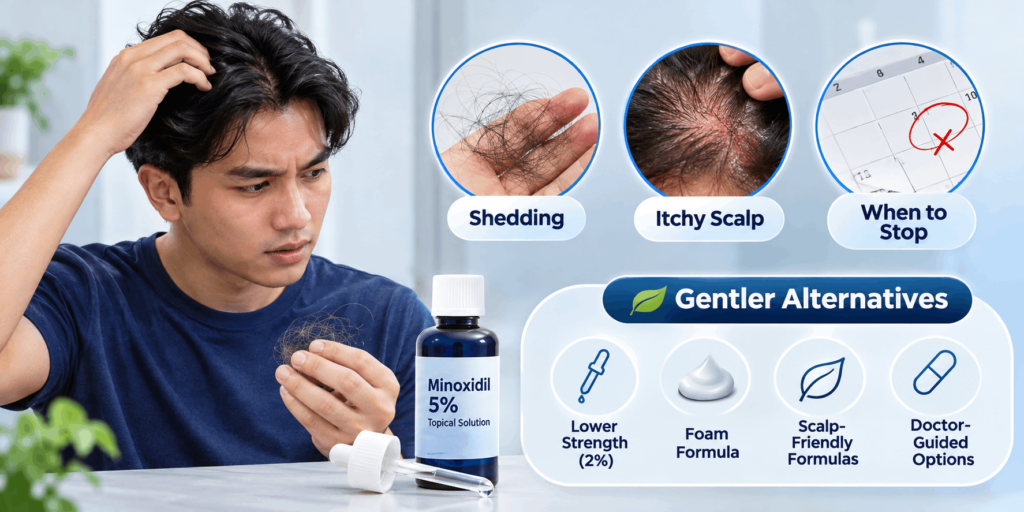
Most minoxidil side effects are mild and stay on the scalp: a temporary shed in the first weeks, plus dryness, itching or flaking. Chest pain, a racing heartbeat, fainting, dizziness, sudden weight gain or swollen hands and feet are different: stop and see a doctor. This guide separates the two, explains what to do about each, and compares the “gentler” alternatives honestly.
| What you notice | How common | What to do |
|---|---|---|
| More hair falling in weeks 2 to 8 | Common, usually temporary | Keep going, track it, see a doctor if it persists |
| Itchy, dry, flaky or red scalp | Most common local effect | Try foam, check technique, stop if it is severe |
| New fine hair on face or temples | Uncommon with topical, more with oral | Apply carefully, use a lower strength, see a doctor if bothersome |
| Chest pain, rapid heartbeat, faintness, dizziness | Rare | Stop and get medical advice |
| Sudden weight gain, swollen hands or feet | Rare | Stop and get medical advice |
This article is general information, not personal medical advice. If you have heart disease, are pregnant or breastfeeding, or use oral minoxidil, talk to your doctor or pharmacist before changing anything.
Shedding: usually temporary, sometimes a warning
A short burst of extra shedding after you start minoxidil is common and usually settles within weeks. The drug pushes resting hairs out of the shedding phase faster so new growing hairs can replace them. One clinic guide describes it as starting 2 to 4 weeks in and lasting roughly 3 to 8 weeks (City Skin Clinic). The Rogaine foam product information puts the increase at two to six weeks after starting, subsiding within a couple of weeks, and says to stop and see a doctor if shedding persists (Rogaine SmPC).
Probably normal:
- Extra hairs on the pillow, brush or shower drain, starting in the first month
- Shedding spread evenly across the thinning area, with no painful or red scalp
- It eases off by about month two or three
Worth a doctor’s visit:
- Shedding that keeps going past the early weeks
- Patchy loss, or loss in areas you were not treating
- Shedding together with burning, a rash or swelling. Untreated allergic contact dermatitis can itself trigger a shedding episode, so inflammation, not the drug working, may be the cause (City Skin Clinic)
Most people see regrowth around 4 months, and the Rogaine label tells users to stop and ask a doctor if there is no regrowth after 4 months (Hims, quoting the label). Sticking with it through the shed is the hard part, but only when the scalp itself looks healthy.
Itchy scalp, dryness and flaking
Scalp irritation is the most common local side effect of topical minoxidil. It can feel like itching, stinging, burning, tightness or soreness, with redness, dryness, scaling or flaking (ChemistClick). Two things drive it: irritant contact dermatitis from the vehicle (the alcohol and propylene glycol base of many liquids) and, less often, a true allergy.
What usually helps:
- Switch from liquid to foam. Many foams are alcohol-free or lower in propylene glycol, and one clinic reports that switching resolves irritation for many users (Vinci Hair Clinic). Check the ingredient list: the Rogaine foam label lists SD alcohol 40-B, so “foam” does not guarantee alcohol-free (label).
- Apply to a dry, healthy scalp and use only the labelled amount. More does not work faster and can increase irritation (ChemistClick).
- Do not apply to broken or inflamed skin. The Rogaine label says not to use it if the scalp is red, inflamed, infected, irritated or painful (label).
- Wash your scalp gently between applications and moisturise only if your doctor or pharmacist agrees.
Mild irritation often settles within two to three months as the scalp adjusts (Vinci Hair Clinic). Severe irritation is a reason to stop and talk to a healthcare professional (GoodRx). Irritation can also increase absorption through the skin, so a severely inflamed scalp is a safety issue, not just a comfort one.
Unwanted facial and body hair
New fine hair on the forehead, temples, cheeks or upper lip is the side effect women worry about most. In trials of topical minoxidil in 1333 women, 4% reported hypertrichosis or facial hair, with the rate rising with strength. Post-marketing reports showed a lower rate of 0.5%. The authors suggest some women have follicles very sensitive to minoxidil and should use the 2% strength.
Who is more at risk: middle-aged women who already have facial hair, and anyone using more than the labelled amount (Actas Dermo-Sifiliográficas).
How to lower the risk:
- Use the lowest effective strength. For women, 2% twice daily or 5% foam once daily is the usual approach
- Never exceed the labelled dose, and do not cover the scalp after applying, since one case report linked scalp occlusion to systemic absorption and hypertrichosis
- Let the product dry before it touches a pillow, hands or a partner’s skin, and wash hands after use
- Keep it away from children: severe hypertrichosis has been reported in infants whose parents used 5 to 7% minoxidil
It is usually reversible. In one published case, severe face and ear hypertrichosis resolved on its own three months after stopping 5% minoxidil (eScholarship). Oral minoxidil carries a much higher rate, covered below.
Heart rate, dizziness and swelling: topical vs oral
Minoxidil was first an antihypertensive that relaxes blood vessels, so heart and fluid effects are the serious end of the side-effect list. With topical use they are rare, because little is absorbed when used as directed, but the risk rises with overuse, damaged skin or occlusion. Anyone with heart disease should ask a doctor before using it, according to the Rogaine label (label).
Low-dose oral minoxidil (LDOM, typically 0.25 to 5 mg a day) is a prescription, off-label option. The largest study to date, a retrospective multicentre review of 1404 patients, found:
| Effect with low-dose oral minoxidil | Rate |
|---|---|
| Hypertrichosis | 15.1% |
| Lightheadedness | 1.7% |
| Fluid retention | 1.3% |
| Tachycardia | 0.9% |
| Headache | 0.4% |
| Periorbital swelling | 0.3% |
| Insomnia | 0.2% |
Only 1.7% stopped treatment because of side effects, and no life-threatening events were seen. The study was retrospective and had no control group. A pooled analysis of 442 patients found hypertrichosis in 24%, pedal oedema in 2%, and heart rate changes in about 1.3%, with higher doses raising the risk.
Stop and get medical advice if you notice:
- Chest pain, rapid heartbeat, faintness or dizziness
- Sudden unexplained weight gain
- Swelling of the hands or feet
These are the stop-use warnings printed on the Rogaine label. Oral minoxidil should only be taken under the supervision of a doctor.
When to stop minoxidil and see a doctor
Stop using it and get medical advice if any of these happen. They follow the stop-use warnings on the product label and in the product information :
- Chest pain, rapid heartbeat, faintness or dizziness
- Sudden, unexplained weight gain
- Swelling of the hands or feet
- Scalp irritation or redness that does not settle, or gets worse
- Unwanted facial hair that bothers you
- Shedding that continues past the early weeks
- No regrowth after 4 months of correct use
Also do not start without checking with a doctor if you have heart disease, a red, inflamed or painful scalp, or sudden or patchy hair loss. The product is not for use in pregnancy or breastfeeding, and the US men’s product is labelled for men only.
Stopping minoxidil also has a consequence: the label notes that continued use is needed to keep regrowth, or hair loss will begin again. That is a reason to talk to a doctor about a different plan rather than just quitting.
Gentler alternatives: Redensyl, Nanoxidil, Renoxil and Aminexil
These are cosmetic or newer ingredients, usually sold in lotions and serums. None is an FDA-approved hair-loss drug, and none has been shown in head-to-head human trials to be gentler or stronger than minoxidil. Treat the “150”, “100” and “50” in product names as brand or formulation labels, not proof of potency. Here is what the evidence actually shows.
| Ingredient | What it is | Human evidence | Honest verdict |
|---|---|---|---|
| Redensyl | Cosmetic complex (including DHQG) from Givaudan | A manufacturer pilot in 26 men with grade 3 to 4 androgenetic alopecia reported more growing hairs (+9%) and fewer resting hairs (-17%) after 84 days; most other studies test multi-ingredient formulas (PMC review) | Limited, mostly manufacturer-linked and not independently replicated (Xyon Health) |
| Nanoxidil | Minoxidil-like molecule marketed as a lower-irritation option | A mouse study and small human studies of one formula, with a reported 28.6% hair-count gain at 3 months in one (Wimpole Clinic); no direct comparison with minoxidil | Early evidence; long-term safety unknown (eMediHealth) |
| Aminexil | Cosmetic diaminopyrimidine oxide from Vichy | An uncontrolled observational study of Aminexil Clinical 5 in mild androgenetic alopecia reported reduced hair loss in 89% of subjects after 3 months (Reygagne et al.); the product also contains other actives | Plausible for slowing loss in mild cases; not proven to regrow hair like minoxidil |
| Renoxil | Peptide-based hair serum ingredient | I could not find independent human trial data. Searches returned patents and marketing only | Unproven; treat claims with caution |
How to read this:
- “Gentler” is mostly a claim about irritation, not a tested outcome. Redensyl, Nanoxidil and Aminexil products can still irritate sensitive scalps, and several are newer so uncommon side effects may be undiscovered.
- Several of the figures above come from the companies that make the ingredients. Look for randomised, independent trials before paying a premium.
- Minoxidil remains the best-studied topical for pattern hair loss, with decades of controlled data; one dermatology-clinic comparison concludes it is still the better first-line option for most people.
If minoxidil irritates you, try this order first:
- Switch from liquid to foam, or to a lower strength your doctor agrees with
- Ask a doctor about oral minoxidil or other proven treatments
- Add a cosmetic ingredient as a supplement, not a replacement, and judge it over at least 3 to 6 months
FAQ
Is shedding a sign minoxidil is working?
It can be, but it is not proof. A short early shed is common, while persistent shedding, patchy loss or shedding with a rash needs a doctor’s review.
Can I use minoxidil if my scalp itches?
Mild itching often settles. If the scalp is red, painful or inflamed, the label says not to apply it, and severe irritation is a reason to stop.
Does minoxidil affect the heart?
Topical use rarely does when used as directed. Chest pain, rapid heartbeat, faintness or dizziness mean stop and get advice. Oral minoxidil needs a prescriber.
Will facial hair go away?
Often yes after stopping, though it can take months. Lower strength and careful application reduce the chance.
Are Redensyl, Nanoxidil, Renoxil or Aminexil safer?
Not proven. They may irritate less for some people, but the evidence is thinner than for minoxidil.