Tretinoin vs Retinol vs Adapalene: Which Retinoid Is Right for You?
Introduction
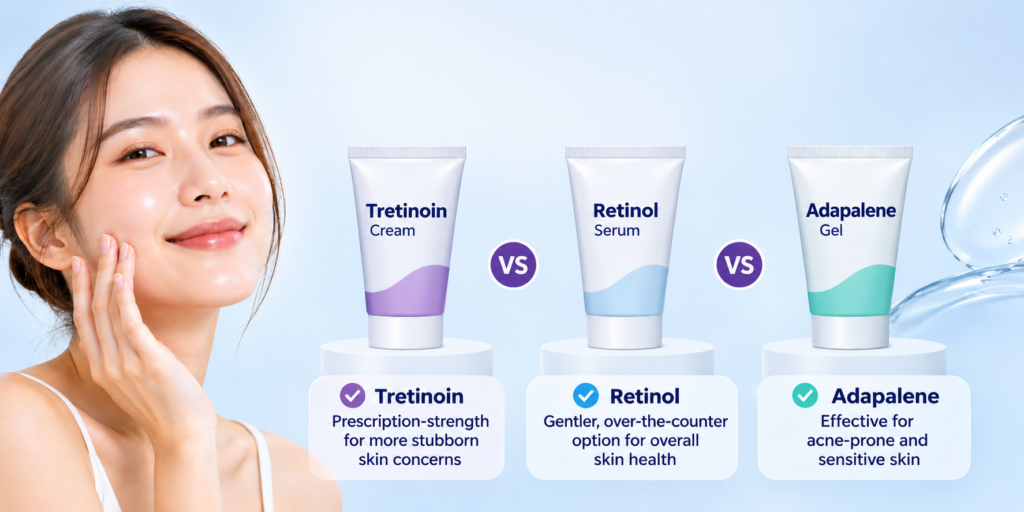
Retinoids are the most evidence-backed topical treatment for acne and skin ageing. But tretinoin, retinol and adapalene are not interchangeable: they differ in strength, how fast they work, how much they irritate, and whether you need a prescription in Malaysia.
The short answer:
- Retinol suits beginners and anyone focused on early signs of ageing. It is the gentlest and is sold over the counter.
- Adapalene suits people whose main concern is acne, especially blackheads, whiteheads and recurring breakouts. It is better tolerated than tretinoin.
- Tretinoin is the strongest option for acne, fine lines and sun damage, but it needs a doctor’s prescription and a slower start.
Not sure which fits your skin? A DoctorOnCall doctor can assess your skin online and prescribe the right retinoid if you need one.
What are retinoids and how do they work?
Retinoids are compounds related to vitamin A. On the skin, they speed up cell turnover, stop dead skin cells from clogging pores, calm inflammation and stimulate collagen production.
The key difference between them is how many steps it takes to reach the active form, retinoic acid:
- Retinol must be converted twice by the skin (retinol → retinaldehyde → retinoic acid). Each step loses potency, so results are slower and milder.
- Tretinoin is retinoic acid itself. It works directly, which is why it is stronger and more irritating.
- Adapalene is a synthetic retinoid that acts directly on specific retinoid receptors in the skin. This targeted action makes it effective for acne with less irritation.
Fewer conversion steps generally means faster, stronger results, and more potential for dryness and peeling.
Tretinoin vs retinol vs adapalene at a glance
| Retinol | Adapalene | Tretinoin | |
|---|---|---|---|
| Type | Vitamin A derivative (cosmetic) | Synthetic third-generation retinoid | Retinoic acid (active form) |
| Strength | Mild | Moderate | Strong |
| Common strengths | 0.1%–1% | 0.1%, 0.3% | 0.025%, 0.05%, 0.1% |
| Main use | Early ageing, texture, beginners | Acne, clogged pores | Acne, fine lines, sun damage, pigmentation |
| Irritation | Low | Low to moderate | Moderate to high |
| Time to see results | 3–6 months | 8–12 weeks | 8–12 weeks |
| Status in Malaysia | Over the counter | Prescription / pharmacist-controlled | Prescription only |
| Light-stable | No (apply at night) | Yes | No (apply at night) |
Each retinoid explained
Retinol: the gentle starting point
Retinol is found in many serums and night creams. Because the skin has to convert it before it works, it is much weaker than prescription retinoids, and also far less likely to cause redness or peeling.
Best for: first-time retinoid users, sensitive skin, early fine lines and uneven texture.
Limitations: results are slow, and it is not strong enough to treat moderate or persistent acne. Product quality varies, as retinol breaks down with light and air.
Adapalene: the acne specialist
Adapalene targets the process that clogs pores, making it particularly effective for blackheads, whiteheads and inflamed pimples. It is more stable than tretinoin and can be used alongside benzoyl peroxide, and is also available as a combination gel with it.
Best for: mild to moderate acne, recurring breakouts, and people who found tretinoin too harsh.
Limitations: it has less evidence than tretinoin for wrinkles and sun damage. Dryness and mild stinging are common in the first few weeks.
Tretinoin: the gold standard
Tretinoin has decades of clinical evidence for both acne and photoageing. It improves fine lines, rough texture, dark spots and acne, making it the most versatile retinoid available.
Best for: moderate acne, visible sun damage, fine lines and pigmentation, under a doctor’s guidance.
Limitations: it is the most irritating of the three, needs a prescription in Malaysia, and must be started slowly to avoid peeling and redness.
Adapalene vs tretinoin: which is better?
For acne alone, adapalene and tretinoin give similar results in clinical studies, but adapalene is usually better tolerated. For ageing and sun damage, tretinoin has the stronger evidence.
Choose adapalene if:
- Acne is your main concern
- Your skin is sensitive or easily irritated
- You want to use it with benzoyl peroxide
- You tried tretinoin and could not tolerate it
Choose tretinoin if:
- You want to treat acne and signs of ageing together
- You have dark spots, rough texture or sun damage
- Your skin has tolerated retinoids before
- Your doctor recommends a stronger treatment
Both require patience. Expect a possible flare (“purging”) in the first 4–6 weeks, with clear improvement around 8–12 weeks of consistent use.
Pairing a retinoid with azelaic acid
Azelaic acid is one of the best partners for a retinoid. It reduces acne-causing bacteria, calms redness and fades post-acne dark marks, filling the gaps a retinoid alone leaves. It is also gentle enough for most skin types.
How to combine them:
- Split the routine: apply azelaic acid in the morning and your retinoid at night. This is the simplest option for most people.
- Alternate nights: if your skin is sensitive, use the retinoid one night and azelaic acid the next.
- Introduce one at a time: start the retinoid first, then add azelaic acid after 2–4 weeks once your skin has adjusted.
Skinoren cream contains 20% azelaic acid and is a well-established option for acne and uneven skin tone. Order it through DoctorOnCall’s online pharmacy with delivery across Malaysia.
How to start a retinoid safely
- Start slow: use a pea-sized amount for the whole face, 2–3 nights a week, and build up to nightly over 4–6 weeks.
- Apply to dry skin: wait 10–20 minutes after cleansing to reduce stinging.
- Moisturise: use a plain, fragrance-free moisturiser. Applying it before the retinoid can buffer irritation.
- Wear sunscreen daily: retinoids make skin more sensitive to the sun. Use SPF 30 or higher every morning, even indoors.
- Avoid stacking actives: pause scrubs, AHAs and BHAs while your skin adjusts.
- Skip delicate areas: keep away from the corners of the nose, mouth and eyes.
Who should avoid retinoids: do not use tretinoin, adapalene or retinol if you are pregnant, trying to conceive or breastfeeding unless a doctor advises otherwise. Speak to a doctor first if you have eczema, rosacea or very sensitive skin.
If irritation is severe, or your skin has not improved after 12 weeks, consult a doctor.
Frequently asked questions
Is adapalene stronger than tretinoin?
No. Tretinoin is generally stronger. Adapalene 0.1% works about as well for acne but with less irritation.
Can I switch from retinol to tretinoin?
Yes. Retinol use can help your skin adjust, but still start tretinoin slowly, a few nights a week.
Can I use adapalene and tretinoin together?
No. Using two retinoids increases irritation without adding much benefit. Pick one.
Do I need a prescription for tretinoin in Malaysia?
Yes. Tretinoin is a prescription-only medicine in Malaysia. You can get a prescription through an online consultation with a DoctorOnCall doctor.
Can I use a retinoid with azelaic acid?
Yes. Use azelaic acid in the morning and your retinoid at night, or alternate nights if your skin is sensitive.