Doxycycline for Acne: Dose, How Long It Takes to Work & What Happens After
Introduction
If your acne keeps coming back as red, painful bumps despite cleansers and creams, your doctor may suggest doxycycline. It is one of the most commonly prescribed oral antibiotics for acne in Malaysia, and it works well when it is used the right way.
The catch: Doxycycline is not a cure on its own, and it is not meant to be taken forever. This guide explains how it works, the usual dose, how long it takes to see results, and what happens to your skin after the course ends.
Quick answer: Doxycycline for acne is usually taken at 50–100 mg a day. Most people notice fewer inflamed spots after 4–6 weeks, with the full effect at around 12 weeks. Courses are normally kept to about 3 months and paired with a topical treatment such as a retinoid or azelaic acid, which you continue afterwards to stop acne returning.
What is doxycycline and how does it work on acne?
Doxycycline is an antibiotic from the tetracycline family. In Malaysia it is a prescription-only medicine, so you need a doctor’s assessment before you can get it.
It helps acne in two ways:
- It reduces acne bacteria. Cutibacterium acnes (formerly P. acnes) lives in clogged pores and feeds the breakouts. Doxycycline lowers the number of these bacteria in the skin.
- It calms inflammation. Doxycycline also has anti-inflammatory effects that are separate from killing bacteria. This is why it works best on red, swollen papules and pustules rather than on blackheads and whiteheads.
What it does not do is unclog pores or stop new blockages forming. That is the job of topical treatments, which is why the two are used together.
Who is doxycycline for?
Doctors usually consider doxycycline for moderate to severe inflammatory acne: lots of red bumps and pus-filled spots, acne on the back or chest, or acne that has not improved after 2–3 months of topical treatment alone. It is not usually needed for mild acne made up mostly of blackheads and whiteheads.
Who should not take doxycycline
Tell your doctor if any of these apply to you, as doxycycline may not be suitable:
- You are pregnant, trying to get pregnant or breastfeeding
- You are under 12 years old (tetracyclines can stain developing teeth)
- You have had an allergic reaction to doxycycline, minocycline or tetracycline
- You are taking isotretinoin (Roaccutane) — the combination raises the risk of increased pressure around the brain
- You have liver problems or a condition such as lupus or myasthenia gravis
- You take blood thinners such as warfarin, or other regular medicines
Doxycycline dose for acne
The usual adult dose for acne is 50 mg to 100 mg once a day. Some doctors start at 100 mg and step down once the skin settles. Your exact dose depends on how severe your acne is, your weight and how you respond, so always follow your prescription.
Unlike a short course for an infection, you take it every day for weeks to months. Skipping doses makes it less effective.
How to take doxycycline safely
- Swallow it with a full glass of water. Doxycycline can irritate or ulcerate the food pipe if it gets stuck.
- Stay upright for at least 30 minutes afterwards. Do not take it right before lying down or going to bed.
- Take it with food if it upsets your stomach. A meal reduces nausea.
- Keep it apart from antacids, iron, calcium and zinc supplements. These bind to doxycycline and stop it being absorbed. Leave a gap of 2–3 hours.
- Protect your skin from the sun. Doxycycline makes skin burn more easily — important in Malaysia’s year-round UV. Use SPF 30+ daily.
- Missed a dose? Take it when you remember, unless it is nearly time for the next one. Never double up.
How quickly does doxycycline work on acne?
Doxycycline is not an overnight fix. Most people see the first improvement after 4 to 6 weeks, and the full effect at around 8 to 12 weeks. Here is what a typical course looks like:
| Time on doxycycline | What you may notice |
|---|---|
| Weeks 1–3 | Little visible change. Some people get mild stomach upset while their body adjusts. |
| Weeks 4–6 | Fewer new red, painful spots. Existing pimples heal a little faster. |
| Weeks 8–12 | Clear reduction in inflamed acne. This is when your doctor reviews whether it is working. |
| After 12 weeks | Doctor decides whether to stop, taper or (rarely) continue for a short extra period. |
If you see no improvement at all after 6–8 weeks of taking it correctly, speak to your doctor. You may need a different treatment rather than a longer course.
Note that dark marks left by old pimples (post-inflammatory hyperpigmentation) fade on a separate, slower timeline. Doxycycline stops new spots; it does not remove existing marks.
How long should you take doxycycline for acne?
Most dermatology guidelines recommend keeping oral antibiotics for acne to about 3 months, reviewed at that point and stopped as soon as the skin is under control. Longer courses are sometimes used, but only with a clear reason and a doctor’s review.
There are three reasons courses are deliberately kept short:
- Antibiotic resistance. The longer acne bacteria are exposed to an antibiotic, the more likely they are to become resistant. Resistant bacteria make future treatment harder, for acne and for other infections.
- Effects on the rest of your body. Long-term antibiotics can disturb the normal bacteria in your gut and on your skin, and raise the chance of side effects.
- It treats flare-ups, not the cause. Acne starts with clogged pores. Doxycycline calms the inflamed phase; a topical treatment is what keeps pores clear long term.
This is why your doctor will almost always prescribe a cream or gel alongside doxycycline, and ask you to keep using it once the tablets stop.
Using doxycycline with acne creams
Doxycycline works best — and is safest — as part of a combination. Guidelines advise against using an oral antibiotic on its own for acne. Your doctor will usually pair it with one of these:
| Topical | What it adds | Good to know |
|---|---|---|
| Tretinoin (a retinoid) [link: tretinoin product page] | Unclogs pores and prevents new blackheads, whiteheads and spots | Can cause dryness and peeling in the first weeks. Both tretinoin and doxycycline increase sun sensitivity, so daily sunscreen is a must. Not for use in pregnancy. |
| Azelaic acid, e.g. Skinoren [link: Skinoren product page] | Reduces bacteria and inflammation, gently unclogs pores, and fades dark acne marks | Usually gentler than retinoids. Helpful for skin prone to post-acne pigmentation, which is common in Asian skin. |
| Benzoyl peroxide | Kills acne bacteria and lowers the risk of antibiotic resistance | Can bleach towels and pillowcases. Often combined with a retinoid or antibiotic gel. |
A simple routine many doctors suggest: doxycycline in the morning with breakfast, sunscreen during the day, and your topical treatment at night. Your doctor will tailor this to your skin.
The key point: the topical is not just a support act. It is the treatment you keep using after doxycycline ends.
Side effects of doxycycline
Most people take doxycycline without serious problems. The most common side effects are:
- Nausea or stomach upset — taking it with food usually helps
- Sun sensitivity — sunburn or rash on sun-exposed skin
- Heartburn or pain when swallowing — a sign the tablet may have irritated your food pipe; take it with plenty of water and stay upright
- Vaginal thrush — antibiotics can upset the natural balance of yeast
When to stop and see a doctor
Seek medical advice promptly if you have:
- A severe headache with blurred or double vision
- Severe or bloody diarrhoea
- A rash with blistering, peeling or swelling of the face, lips or tongue
- Yellowing of the skin or eyes
Medicines and supplements to watch
Antacids, iron, calcium, magnesium and zinc reduce how much doxycycline your body absorbs. Doxycycline should not be combined with isotretinoin, and it can interact with blood thinners such as warfarin. Always tell your doctor or pharmacist what else you take, including supplements and traditional remedies.
Will acne come back after you stop doxycycline?
It can — especially if you stop everything at once. Doxycycline controls inflamed acne while you take it, but it does not change the oil production and pore-clogging that cause acne in the first place. Without a maintenance plan, breakouts often return within weeks to months.
The good news is that relapse is largely preventable:
- Keep using your topical treatment. A retinoid such as tretinoin, or azelaic acid, is the standard maintenance therapy after an antibiotic course. Many people stay on it for months or longer.
- Do not restart old tablets on your own. If acne flares again, see a doctor. Repeating antibiotics without review raises the risk of resistance.
- Stick to a simple routine. A gentle cleanser, non-comedogenic moisturiser and daily sunscreen support your treatment.
- Know the next options. If acne keeps returning or leaves scars, your doctor may discuss other treatments, such as hormonal therapy for women or isotretinoin for severe acne.
Think of doxycycline as the phase that gets acne under control, and your topical as the phase that keeps it there.
Frequently asked questions
Can I buy doxycycline for acne without a prescription in Malaysia?
No. Doxycycline is a prescription-only medicine in Malaysia. A doctor needs to check that it suits your acne type and your health before prescribing it.
Is doxycycline 100 mg strong for acne?
100 mg a day is a standard acne dose, not an unusually high one. Some people do well on 50 mg. Your doctor chooses the lowest dose that controls your acne.
Can I drink alcohol while taking doxycycline?
Occasional light drinking is unlikely to cause problems for most people, but heavy or regular drinking can make doxycycline less effective. Ask your doctor if you drink often.
Does doxycycline affect birth control pills?
Current evidence suggests doxycycline does not reduce the effect of the combined pill for most people. If you have vomiting or diarrhoea, though, the pill may not be absorbed properly. Check with your doctor or pharmacist.
Why did my acne get worse at the start?
Some people notice no change or a few new spots in the first weeks while the medicine builds up. If it is getting clearly worse or painful, speak to your doctor.
Doxycycline 100mg: What It Treats, How to Take It & What to Avoid
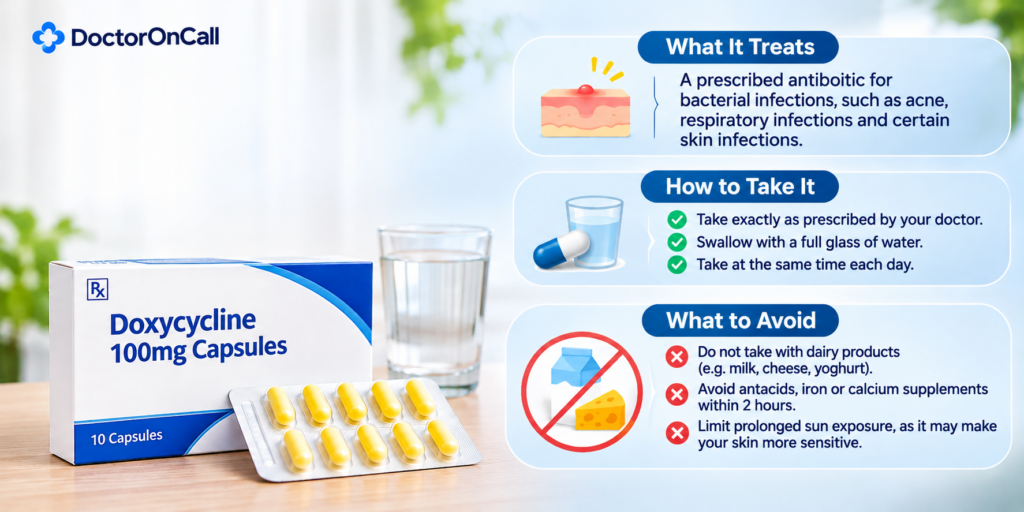
Doxycycline 100mg is a prescription antibiotic used for chest infections, acne, some sexually transmitted infections and malaria prevention. It works well, but only when taken the right way: with a full glass of water, staying upright, and away from antacids, iron and dairy.
This guide explains what doxycycline treats, how to take it, what to avoid, and how to get it safely in Malaysia. In Malaysia, doxycycline is a prescription-only medicine, so you will need a doctor’s assessment before you can buy it.
What is doxycycline 100mg used to treat?
Doxycycline is a broad-spectrum antibiotic from the tetracycline family. It stops bacteria from making the proteins they need to grow. Doctors commonly prescribe it for:
- Respiratory infections, such as some types of pneumonia, bronchitis and sinusitis
- Acne and rosacea, usually as a longer course alongside skin treatments
- Sexually transmitted infections, including chlamydia
- Malaria prevention for travellers to high-risk areas
- Leptospirosis and scrub typhus, infections seen in Malaysia after flood, outdoor or jungle exposure
- Some urinary tract, skin and eye infections
Doxycycline does not work on viruses. It will not help a cold, flu or COVID-19.
Is doxycycline a strong antibiotic?
Doxycycline is broad-spectrum, meaning it covers many types of bacteria, including some that other antibiotics miss. But “strong” is the wrong way to judge an antibiotic. What matters is whether it matches the bacteria causing your infection.
That is why a doctor should choose it for you. Taking the wrong antibiotic, or stopping a course early, can leave the infection untreated and help bacteria become resistant. Always finish the full course, even if you feel better after a few days.
How to take doxycycline 100mg
Your dose depends on the infection. A common pattern is 200mg on the first day, then 100mg once or twice a day, but follow exactly what your doctor and the label say.
- Swallow the capsule whole with a full glass of water. Doxycycline can irritate and even ulcerate the food pipe (oesophagus) if it gets stuck.
- Stay upright for at least 30 minutes afterwards. Sit or stand; do not lie down.
- Take it with food if it upsets your stomach. A meal reduces nausea and does not stop doxycycline working.
- Space your doses evenly. If you take it twice daily, aim for about 12 hours apart.
- Missed a dose? Take it when you remember, unless your next dose is soon. Never take two doses together.
- Finish the course, even when symptoms go away.
Why is doxycycline sometimes given at night?
Some doctors suggest taking doxycycline with your evening meal. Food eases nausea, and an evening dose keeps it away from a morning milk drink or supplement.
But do not take it right before bed. Lying down soon after a dose is the main cause of doxycycline-related throat and oesophagus pain. Take your evening dose at least 30 minutes, ideally an hour, before you lie down.
What to avoid while taking doxycycline
Certain minerals bind to doxycycline in the gut and stop it being absorbed. Keep these at least 2–3 hours away from your dose:
| Avoid near your dose | Why |
|---|---|
| Antacids (e.g. for gastric or heartburn) | Aluminium, calcium and magnesium block absorption |
| Iron, calcium, zinc or magnesium supplements, multivitamins | Same binding effect |
| Milk, cheese, yoghurt, calcium-fortified drinks | Calcium reduces absorption; a small amount with a meal is less of a problem than a large glass of milk |
| Strong sun without protection | Doxycycline makes skin burn much faster; use SPF 30+, cover up, avoid midday sun |
| Heavy or regular drinking | Can lower doxycycline levels and worsen stomach side effects |
Tell your doctor about every medicine you take. Doxycycline can interact with isotretinoin (acne tablets), warfarin, some epilepsy medicines and penicillin antibiotics.
Side effects and when to see a doctor
Most people take doxycycline without problems. Common side effects are usually mild:
- Nausea, stomach upset or diarrhoea
- Sunburn or a rash on sun-exposed skin
- Vaginal or oral thrush
Stop and get medical help quickly if you have: pain or difficulty swallowing, severe or bloody diarrhoea, a severe headache with blurred or double vision, or signs of an allergic reaction such as swelling of the face, lips or throat, or a spreading rash.
Doxycycline is usually not suitable if you are: pregnant, breastfeeding, a child under 8 (it can stain developing teeth), or allergic to any tetracycline antibiotic. Tell your doctor if you have liver problems.
Getting doxycycline 100mg in Malaysia
Doxycycline is a prescription-only medicine in Malaysia. A common local brand is Duopharma’s Doxycillin 100mg capsules, available through licensed pharmacies.
You don’t need to queue at a clinic to get it. With DoctorOnCall, you can speak to a Malaysian-registered doctor online, explain your symptoms and get a proper assessment. If doxycycline is right for you, the doctor can issue an e-prescription and your medicine is delivered to your door.
Frequently asked questions
What is doxycycline 100mg used to treat?
Bacterial infections such as chest infections, acne, chlamydia, leptospirosis and some skin and urinary infections. It is also used to prevent malaria when travelling.
Is doxycycline a strong antibiotic?
It is broad-spectrum and effective against many bacteria, but it only works if it matches your infection. A doctor should decide whether it is the right choice.
What should I avoid while taking doxycycline?
Antacids, iron or calcium supplements and dairy within 2–3 hours of a dose, lying down within 30 minutes of a dose, and strong sun without protection.
Can I take doxycycline at night?
Yes, with your evening meal, but take it at least 30 minutes to an hour before you lie down.
How long does doxycycline take to work?
Many people feel better within 2–3 days for common infections; acne can take several weeks. Finish the full course either way.
Can I buy doxycycline without a prescription in Malaysia?
No. It is prescription-only. You can get a prescription through an online consultation with a DoctorOnCall doctor.
Doxycycline Side Effects: Sun Sensitivity, Stomach Upset & When to See a Doctor

Introduction
Doxycycline is one of the most commonly prescribed antibiotics in Malaysia, used for acne, chest and urinary infections, some sexually transmitted infections, and malaria prevention when travelling. Most people take it without any trouble, but a few side effects are common enough that it pays to know them before your first dose.
The good news: the two biggest complaints, sunburn and stomach or throat irritation, are largely preventable with a few simple habits.
Quick answer
- Most common side effects: nausea, stomach upset, diarrhoea and increased sensitivity to sunlight.
- Most avoidable side effect: throat or food-pipe irritation, which happens when the capsule sticks on the way down. Take it with a full glass of water and stay upright for at least 30 minutes.
- What to avoid: milk, antacids, and iron, calcium or zinc supplements within 2–3 hours of your dose, plus strong midday sun.
- See a doctor urgently if you have a severe rash, blistering skin, swelling of the face or throat, a severe headache with blurred vision, or watery or bloody diarrhoea.
What are the common side effects of doxycycline?
The common side effects are mild and usually settle once your body adjusts or the course ends.
| Side effect | What it feels like | What helps |
|---|---|---|
| Nausea or vomiting | Queasiness soon after a dose | Take it with a meal (not with milk) |
| Stomach pain or indigestion | Discomfort or burning in the upper tummy | Take with food and a full glass of water |
| Diarrhoea | Loose stools | Drink fluids; tell a doctor if it is watery, bloody or lasts more than a few days |
| Sun sensitivity | Sunburn faster or worse than usual, rash on sun-exposed skin | Sunscreen, cover up, avoid midday sun |
| Throat or chest pain on swallowing | Burning behind the breastbone, pain when swallowing | Full glass of water, stay upright 30 minutes |
| Headache | Mild, general headache | Rest and fluids; seek help if severe with vision changes |
| Vaginal thrush | Itching and thick white discharge | Antifungal treatment; speak to a pharmacist or doctor |
Doxycycline can also make the contraceptive pill slightly less reliable if it causes vomiting or diarrhoea. If you are unsure, ask your doctor whether to use extra protection during the course.
Doxycycline and sun sensitivity in Malaysia
Doxycycline makes your skin react more strongly to UV light, so you can burn in a fraction of the usual time. This is called photosensitivity, and it matters more in Malaysia, where the UV index sits in the high-to-extreme range for much of the year, even on cloudy days.
A reaction usually looks like an unusually quick or painful sunburn on the face, neck, arms or hands. Some people get a rash, and in rare cases the nails can lift away from the nail bed. The effect can linger for a few days after your last dose.
How to protect your skin while on doxycycline
- Apply a broad-spectrum sunscreen of SPF 30 or higher before going out, and reapply every 2 hours or after sweating.
- Avoid direct sun between about 11am and 4pm, when UV is strongest.
- Cover up with a hat, sunglasses, long sleeves or an umbrella for your commute, outdoor lunch or school run.
- Plan ahead for beach trips, sports, hiking or balik kampung driving. Car windows block less UV than you might think.
- Avoid tanning beds completely.
If you take doxycycline for malaria prevention on a trip, or for acne over several months, sun protection becomes a daily habit rather than a one-off. Stock up on sunscreen before you start your course.
Stomach upset and throat irritation: how to take doxycycline properly
Most stomach and throat problems come from how the medicine is taken, not the medicine itself. If a capsule or tablet sticks in your food pipe (oesophagus), it can cause painful irritation or even an ulcer.
- Swallow each dose whole with a full glass of water (about 200–250ml).
- Stay sitting or standing upright for at least 30 minutes afterwards.
- Don’t take it just before bed. Take your evening dose at dinner or at least an hour before lying down.
- Take it with food if it upsets your stomach. A meal reduces nausea without stopping the medicine working.
- Keep doses evenly spaced, as prescribed, and finish the full course even if you feel better.
If swallowing becomes painful, or you feel burning behind your breastbone, stop and speak to a doctor before your next dose.
What to avoid when taking doxycycline
Some foods and medicines bind to doxycycline in the gut and stop it being absorbed, so keep them 2–3 hours away from each dose.
| Avoid or separate | Why | What to do |
|---|---|---|
| Milk, cheese, yoghurt, milk tea (teh tarik, Milo) | Calcium reduces absorption | Have them 2–3 hours before or after your dose |
| Antacids and indigestion remedies | Aluminium, magnesium and calcium bind the drug | Separate by 2–3 hours; ask a pharmacist for an alternative |
| Iron, calcium, zinc or magnesium supplements, multivitamins | Minerals block absorption | Separate by 2–3 hours, or pause during a short course |
| Strong sun and tanning beds | Higher risk of sunburn | See sun protection above |
| Heavy drinking | Can lower doxycycline levels and worsen stomach upset | Keep alcohol light, or avoid it during the course |
| Isotretinoin (oral acne treatment) | Both can raise pressure around the brain | Never combine unless your doctor says so |
| Blood thinners such as warfarin | Doxycycline can increase their effect | Tell your doctor; you may need extra checks |
Who should not take doxycycline
Doxycycline is generally not given during pregnancy or to children under 8, because it can affect developing teeth and bones. If you are pregnant, could be pregnant, or are breastfeeding, tell your doctor before starting.
When to see a doctor
Serious side effects are rare, but some need same-day attention. Stop taking doxycycline and get help if you notice any of the following.
Call 999 or go to the nearest emergency department if you have:
- Swelling of the face, lips, tongue or throat, or difficulty breathing (a severe allergic reaction).
- A widespread rash with blistering, peeling skin or sores in the mouth, eyes or genitals.
See a doctor the same day if you have:
- A severe or persistent headache with blurred or double vision, which can signal raised pressure around the brain.
- Watery or bloody diarrhoea, especially with stomach cramps or fever, during or up to a few weeks after the course.
- Severe pain when swallowing, or chest pain after taking a dose.
- Yellowing of the skin or eyes, dark urine or pain in the upper right tummy.
- A sunburn that blisters badly or covers a large area.
Speak to a doctor or pharmacist soon if:
- Nausea or diarrhoea is stopping you from eating, drinking or keeping your doses down.
- You get vaginal thrush or a sore, white-coated tongue.
- Your symptoms are not improving after a few days of treatment.
Frequently asked questions
What are the major side effects of doxycycline?
The most common are nausea, stomach upset, diarrhoea and sun sensitivity. Throat irritation is also common when the dose isn’t taken with enough water. Serious reactions such as severe allergy, blistering rashes or severe headache with vision changes are rare.
What should I avoid when using doxycycline?
Keep milk, dairy, antacids, and iron, calcium, zinc or magnesium supplements 2–3 hours away from each dose. Limit sun exposure, avoid lying down right after a dose, and keep alcohol light.
When should I worry about doxycycline side effects?
Seek urgent help for facial or throat swelling, difficulty breathing, blistering skin, a severe headache with blurred vision, or watery or bloody diarrhoea. See a doctor if milder side effects stop you taking your doses.
How long does sun sensitivity last after stopping doxycycline?
It usually fades within a few days of your last dose. Keep using sunscreen for about a week to be safe.
Can I take doxycycline on an empty stomach?
You can, but it is more likely to cause nausea. Taking it with a meal (not with milk) is usually easier on the stomach.
Can I drink coffee or tea with doxycycline?
Black coffee and plain tea are fine. Avoid adding milk around your dose time, and still take the tablet with a full glass of water.
Azelaic Acid in Malaysia: Skinoren 20% vs The Ordinary, Anua & Other 10% Serums
Is azelaic acid banned in Malaysia?
No. Azelaic acid is a legal, registered medicine in Malaysia. Skinoren 20% cream is approved by the National Pharmaceutical Regulatory Agency (NPRA) and dispensed through pharmacies.
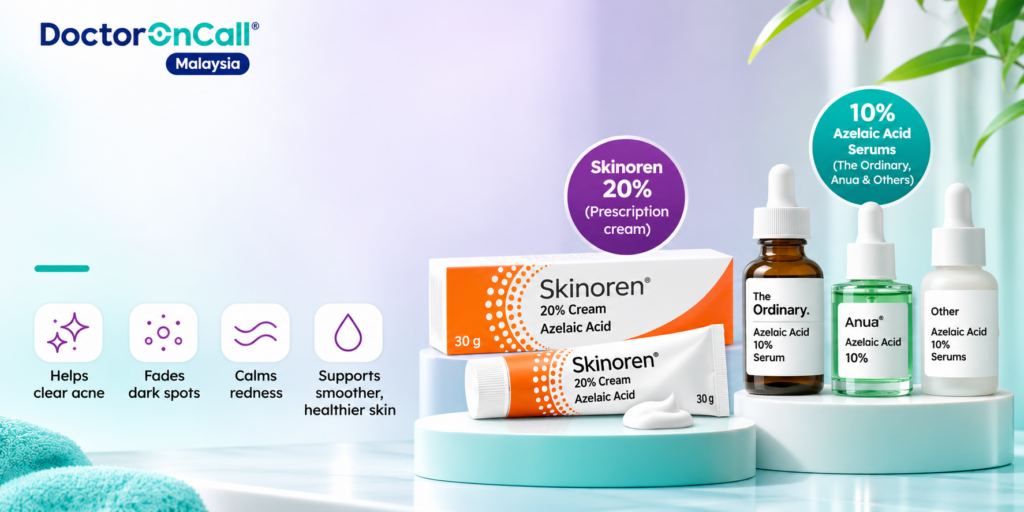
The confusion comes from the cosmetic side. 10% azelaic acid serums from brands such as The Ordinary and Anua are regulated as cosmetics, not medicines, and their availability in Malaysia depends on NPRA cosmetic notification.
This guide explains the difference between a 20% medicine and a 10% serum, compares the main brands Malaysians search for, and sets out when each option makes sense.
What azelaic acid does
Azelaic acid is a naturally occurring dicarboxylic acid, originally found in grains such as wheat and barley. In skin, it works in three ways:
- Antibacterial: reduces Cutibacterium acnes, the bacteria linked to inflamed acne.
- Unclogs pores: normalises how skin cells shed inside the follicle, reducing blackheads and whiteheads.
- Evens tone: inhibits tyrosinase, the enzyme behind excess pigment, which helps fade post-acne marks.
It also calms redness, which is why it is used for rosacea. At 20%, it is indicated for acne vulgaris. At 15%, gel formulations such as Finacea are indicated for papulopustular rosacea. Lower-strength serums are used for general redness, texture and uneven tone.
20% medicine vs 10% serum: why the rules differ
The same ingredient sits under two regulatory systems in Malaysia, depending on strength and the claim made for the product.
Registered medicine (Skinoren 20%, Finacea 15%)
Products that treat a skin condition must be registered with NPRA and carry a MAL number. The registration covers clinical evidence of efficacy, manufacturing quality and labelled dosing. Skinoren is supplied through pharmacies. [Verify: whether a doctor’s prescription is required or pharmacist supply is sufficient.]
Cosmetic (10% serums)
Cosmetics are notified to NPRA rather than registered, and may only make cosmetic claims such as “improves the look of uneven tone”. They cannot claim to treat acne or rosacea. Whether azelaic acid is permitted in a notified cosmetic, and at what level, is set by NPRA’s cosmetic guidelines. [Verify and insert the confirmed position here. If cosmetic use is not permitted, state that clearly and note that serums sold locally without a notification are not checked for quality or safety.]
What this means for buyers
A product with a MAL number has been assessed for what it claims to do. Before buying any azelaic acid serum, check the notification status on the NPRA website and buy from an authorised seller.
Skinoren vs Finacea vs The Ordinary vs Anua
Skinoren is the only option in this list with a 20% strength and an acne indication. The serums are lower-strength cosmetic products designed for tone and redness.
| Product | Strength | Format | Category in Malaysia | Best suited to |
|---|---|---|---|---|
| Skinoren | 20% | Cream | Registered medicine [verify MAL no.] | Mild to moderate acne, post-acne marks |
| Finacea | 15% | Gel | Registered medicine [verify] | Papulopustular rosacea |
| The Ordinary Azelaic Acid Suspension | 10% | Cream-gel | Cosmetic [verify notification] | Uneven tone, texture, mild redness |
| Anua Azelaic Acid 10 + Hyaluron Redness Soothing Serum | 10% [verify INCI] | Serum | Cosmetic [verify notification] | Redness, sensitive or dehydrated skin |
| Paula’s Choice 10% Azelaic Acid Booster | 10% | Cream-gel | Cosmetic [verify notification] | Uneven tone, layering into a routine |
A note on labels: some serums use azelaic acid derivatives such as potassium azeloyl diglycinate. These are gentler but are not the same molecule and have far less clinical data. Check the ingredient list, not just the product name.
Which one should you choose?
Match the product to the problem. Strength matters most when you are treating a condition, not maintaining skin.
Choose a 20% medicine such as Skinoren if:
- You have active acne: inflamed spots, blackheads or whiteheads that keep returning
- You have dark marks left after breakouts
- A 10% serum has not made a visible difference after 8 to 12 weeks
Ask a doctor about a rosacea-specific option if:
- You have persistent facial redness with bumps or pustules, flushing, or visible blood vessels
- Your redness worsens with heat, spicy food or alcohol
A 10% serum may be enough if:
- Your skin is clear but tone is uneven or slightly red
- You want a gentle step in a maintenance routine
- You have confirmed the product is legally notified in Malaysia
See a doctor first if your acne is painful, cystic, scarring, or affecting your confidence. These need more than a topical and should be assessed.
How to use it safely
Follow the label or your pharmacist’s instructions. For Skinoren 20% cream, the usual pattern is:
- Cleanse and pat skin dry.
- Apply a thin layer to the whole affected area, typically twice daily.
- Avoid eyes, mouth and other mucous membranes; wash hands after use.
- Use daily sunscreen, especially when treating pigmentation.
Improvement in acne is usually seen within about four weeks, with treatment often continued for several months.
Common side effects: burning, stinging, itching or dryness in the first weeks, which usually settles. Starting once daily can help. Stop and seek advice if irritation is severe or persistent. Rarely, lightening of skin colour has been reported in people with darker skin tones.
Pregnancy and breastfeeding: topical azelaic acid is generally considered one of the more suitable acne options in pregnancy because very little is absorbed. Speak to a doctor or pharmacist before starting any treatment while pregnant or breastfeeding.
Combining with other actives: azelaic acid can be used alongside niacinamide and moisturisers. Introduce it separately from retinoids, AHAs or BHAs to limit irritation.
Frequently asked questions
Is azelaic acid legal in Malaysia?
Yes. Azelaic acid is available in Malaysia as a registered medicine, such as Skinoren 20% cream, supplied through pharmacies.
Why do some websites say azelaic acid is banned in Malaysia?
The claim relates to cosmetic serums, not the medicine.
Can I buy The Ordinary or Anua azelaic acid in Malaysia?
Check that the product has a valid NPRA cosmetic notification and is sold by an authorised retailer. Products without notification have not been checked for quality in Malaysia.
Is Skinoren stronger than The Ordinary azelaic acid?
Yes. Skinoren contains 20% azelaic acid and is a registered acne treatment. The Ordinary’s suspension contains 10% and is a cosmetic.
Can I use azelaic acid every day?
Yes, it is designed for daily use, usually once or twice a day. Start slowly if your skin is sensitive.
Does azelaic acid remove acne scars?
It can fade flat dark marks left after acne. It does not treat raised or indented scars, which need in-clinic procedures.
What Does Azelaic Acid Do? Benefits for Acne, Rosacea & Dark Spots (and How to Use It)
Introduction
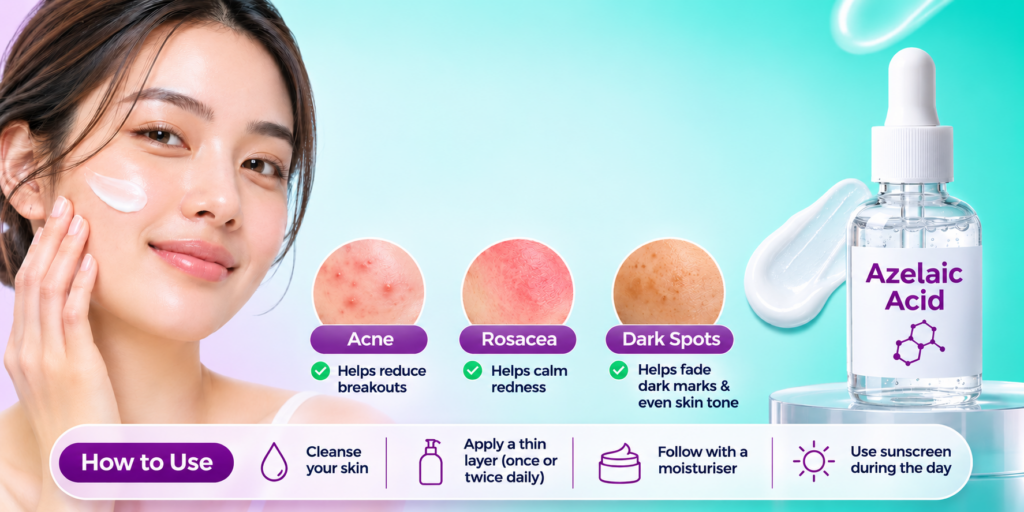
Most skincare actives do one job. Azelaic acid does three: it clears acne, calms rosacea redness and fades dark spots, and it does so gently enough for sensitive skin.
So what does azelaic acid do, exactly? In short, it kills acne-causing bacteria, keeps pores from clogging, reduces inflammation and slows excess pigment production. That combination is why dermatologists reach for it when skin is breaking out, flushing and marking up all at once.
This guide covers how azelaic acid works, its proven benefits, what to expect week by week, how to add it to your routine, its side effects, and which azelaic acid product suits your skin.
What is azelaic acid?
Azelaic acid is a naturally occurring dicarboxylic acid found in grains such as wheat, barley and rye. It is also produced by Malassezia, a yeast that lives on normal skin. The versions used in skincare and medicine are made in a lab for purity and consistent strength.
It comes in two main strengths:
- Medical-strength (15–20%) — creams and gels such as Skinoren 20% Cream, used to treat acne, and 15% gels used for rosacea.
- Cosmetic-strength (around 10% or less) — serums and suspensions sold for redness, texture and uneven tone.
How azelaic acid works on skin
Azelaic acid targets several causes of breakouts and discolouration at once:
- Antibacterial — it reduces Cutibacterium acnes (formerly Propionibacterium acnes), the bacteria linked to inflamed acne, without the resistance risk of topical antibiotics.
- Unclogs pores — it normalises how skin cells shed inside the follicle, so fewer blackheads and whiteheads form.
- Anti-inflammatory — it calms the redness, bumps and swelling seen in acne and rosacea.
- Brightening — it slows tyrosinase, the enzyme that drives melanin production, mainly in overactive pigment cells. That is why it fades dark marks without lightening normal skin tone.
Azelaic acid benefits: what it treats
1. Azelaic acid for acne
Azelaic acid 20% is an established topical treatment for mild to moderate acne. It works on both types of spots: inflamed papules and pustules, and non-inflamed blackheads and whiteheads.
It is a good fit when:
- Benzoyl peroxide or retinoids have been too harsh for your skin
- You want to avoid long-term topical antibiotics
- Your acne leaves dark marks behind, since azelaic acid treats the spot and the mark together
2. Azelaic acid for rosacea
For papulopustular rosacea (the type with red bumps and pus-filled spots), azelaic acid 15% gel is a recognised first-line treatment. It reduces the bumps, lesions and background redness by calming inflammation in the skin.
It does not remove visible broken blood vessels, and flushing triggers such as heat, spicy food and alcohol still need managing alongside treatment.
3. Azelaic acid for dark spots and melasma
Azelaic acid fades hyperpigmentation by slowing melanin production in overactive pigment cells. Doctors use it for:
- Post-inflammatory hyperpigmentation (PIH) — the brown or dark marks left after acne, common in Asian and darker skin tones
- Melasma — patchy brown pigmentation on the cheeks, forehead and upper lip, often linked to hormones and sun exposure
- Uneven skin tone and sun spots
Because it targets overactive pigment cells rather than all of them, it is often chosen as an alternative to hydroquinone for long-term use. Daily sunscreen is essential, or the pigment will keep coming back.
4. Other benefits
- Smoother texture — regular use refines rough, bumpy skin by keeping pores clear.
- Suitable for sensitive skin — it is generally better tolerated than retinoids and strong exfoliating acids.
- Used in pregnancy — it is one of the acne treatments doctors commonly consider during pregnancy and breastfeeding, but always check with your doctor first.
Azelaic acid before and after: when will you see results?
Azelaic acid works steadily, not overnight. Most people notice a difference in acne within about 4 weeks, with fuller results after 2–3 months of twice-daily use.
| Timeframe | What to expect |
|---|---|
| Weeks 1–2 | Mild tingling or itching as skin adjusts; usually settles on its own |
| Weeks 4–6 | Fewer new breakouts, less redness and fewer rosacea bumps |
| Weeks 8–12 | Clearer skin overall; dark marks start to look lighter |
| 3–6 months | Most visible fading of melasma and post-acne marks, with daily sunscreen |
Results vary with skin type, severity and how consistently you apply it. If you see no improvement after about 3 months, speak to a doctor about adjusting your treatment.
Image note: add a before-and-after illustration or a licensed patient image here, with alt text “azelaic acid before and after acne results”.
How to use azelaic acid
- Cleanse with a gentle, non-foaming cleanser and pat skin completely dry.
- Apply a thin layer to the whole affected area, not just individual spots, and rub in gently. A pea-sized amount covers the face.
- Use it twice a day, morning and evening, or as directed by your doctor. Sensitive skin can start once a day and build up.
- Moisturise after it has absorbed.
- Wear SPF 30 or higher every morning, especially if you are treating dark spots.
- Wash your hands after applying, and keep it away from your eyes, mouth and the inside of your nose.
Can you use azelaic acid with other actives?
| Combination | Verdict |
|---|---|
| Azelaic acid + niacinamide | Works well together for redness and pigmentation |
| Azelaic acid + hyaluronic acid or ceramides | Good pairing; hydration helps reduce irritation |
| Azelaic acid + retinoids (e.g. tretinoin, adapalene) | Can be combined, often at different times of day; introduce one at a time |
| Azelaic acid + benzoyl peroxide | Sometimes prescribed together; may increase dryness |
| Azelaic acid + AHAs/BHAs or vitamin C | Use on alternate nights or different times of day to avoid irritation |
If you are already on prescription acne treatment, ask your doctor before adding azelaic acid.
Azelaic acid side effects
Azelaic acid is well tolerated by most people. The common side effects are mild and usually fade within the first few weeks:
- Burning, stinging or tingling when applied
- Itching
- Dryness, flaking or mild redness
Less commonly, some people notice lighter patches of skin, which has been reported mainly in darker skin tones. Stop using it and see a doctor if you have severe irritation, swelling, blistering or signs of an allergic reaction.
Who should check with a doctor first
- Pregnant or breastfeeding women
- People with very sensitive skin, eczema or a history of reactions to skincare
- Anyone with asthma, as worsening has been reported rarely
- Anyone already using prescription acne or rosacea treatments
Which azelaic acid product should you use?
The right product depends on what you are treating and how severe it is. Medical-strength azelaic acid gives the strongest, best-studied results; lower-strength serums suit maintenance and mild concerns.
| Your concern | Recommended option |
|---|---|
| Mild to moderate acne with post-acne dark marks | Skinoren 20% cream |
| Rosacea bumps and redness | 15% azelaic acid gel, after a doctor’s consultation |
| Melasma or stubborn pigmentation | 15–20% azelaic acid with daily SPF 50; see a doctor if patches persist |
| Mild redness, texture or uneven tone | Cosmetic azelaic acid serum (around 10%) |
Skinoren 20% cream
Skinoren is one of the best-known medical azelaic acid creams. It contains 20% azelaic acid to reduce acne-causing bacteria, unclog pores and fade the dark marks breakouts leave behind. It is suitable for long-term use and gentle enough for skin that cannot tolerate stronger acne treatments.
Not sure which one suits your skin?
Acne, rosacea and melasma can look alike, and each needs a different plan. Speak to a DoctorOnCall pharmacist or doctor online for advice on the right product and strength for your skin.
Frequently asked questions
Can I use azelaic acid every day?
Yes. Azelaic acid is designed for daily use, usually twice a day. If your skin is sensitive, start once a day and increase as it adjusts.
Is azelaic acid better than niacinamide?
They do different jobs and work well together. Azelaic acid treats acne, rosacea and pigmentation more directly, while niacinamide supports the skin barrier and reduces redness and oil.
Does azelaic acid help with acne scars?
It fades flat dark or red marks left by acne. It does not fill in pitted or indented scars, which need in-clinic treatments such as microneedling or lasers.
Should I use azelaic acid in the morning or at night?
Both are fine. Most treatment plans use it twice daily, and it does not make skin more sensitive to the sun. Always follow with sunscreen in the morning.
Is azelaic acid safe during pregnancy?
Azelaic acid is one of the acne treatments doctors commonly consider during pregnancy and breastfeeding. Speak to your doctor before starting any treatment while pregnant.
Does azelaic acid cause purging?
Purging is uncommon with azelaic acid. Mild stinging or itching in the first weeks is more typical. Breakouts that keep getting worse should be checked by a doctor.
Skinoren 20% Cream (Azelaic Acid): Uses for Acne & Pigmentation, How to Apply & Price
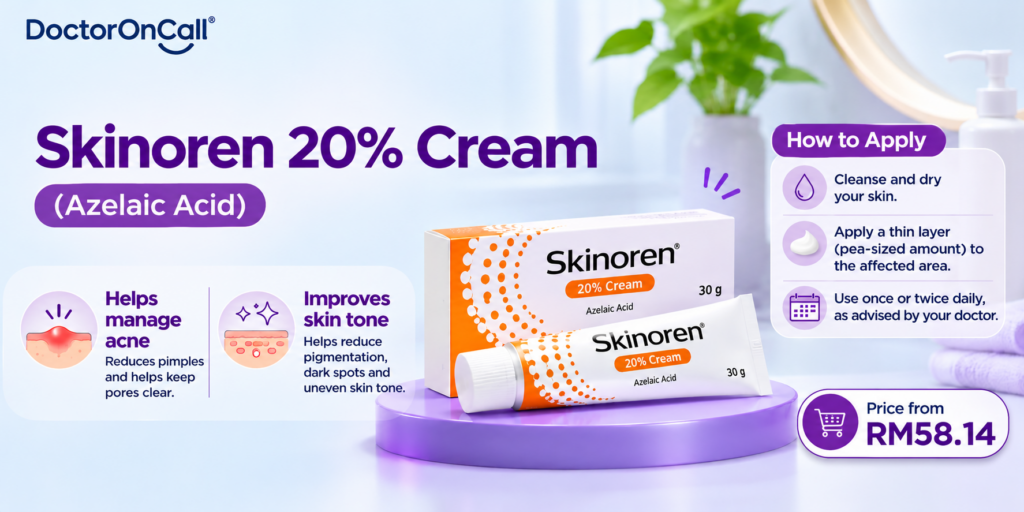
Skinoren 20% Cream is an azelaic acid cream used to treat mild to moderate acne and to fade dark spots such as melasma and post-acne marks. It works by clearing blocked pores, killing acne-causing bacteria and calming redness, and it is gentle enough for most skin types, including sensitive skin.
If you have been searching for Skinoren, you have probably seen it recommended for everything from breakouts to stubborn pigmentation. This guide covers what it actually does, how to apply it properly, how long it takes to work, the side effects to expect and how to make sure the tube you buy is genuine.
Skinoren at a glance
- Active ingredient: Azelaic acid 20%
- Used for: Acne (blackheads, whiteheads, red bumps) and hyperpigmentation such as melasma and dark marks
- How often: Twice a day, morning and night
- Results: Usually visible after about 4 weeks for acne; pigmentation can take 2 to 3 months
- Common side effects: Mild burning, itching or stinging in the first weeks, which usually settles
- Where to buy: Licensed pharmacies, including DoctorOnCall
What is Skinoren and how does azelaic acid work?
Skinoren is a topical cream containing 20% azelaic acid, a naturally occurring acid also found in grains such as wheat and barley. It is made by LEO Pharma and is one of the most widely prescribed azelaic acid products worldwide.
Azelaic acid tackles skin problems in four ways:
- Antibacterial: It reduces Cutibacterium acnes, the bacteria that drive inflamed acne. Unlike antibiotics, bacteria are not known to develop resistance to it.
- Unclogs pores: It normalises how skin cells shed inside the follicle, which helps prevent blackheads and whiteheads (comedones).
- Anti-inflammatory: It calms the redness and swelling around pimples.
- Evens skin tone: It slows down overactive pigment cells (melanocytes) by blocking tyrosinase, the enzyme that makes melanin. It mostly targets cells that are overproducing pigment, so normal skin is largely unaffected.
Can Skinoren reduce inflammation?
Yes. Azelaic acid has proven anti-inflammatory effects, which is why it helps with red, swollen pimples and why azelaic acid is also used for rosacea. Note that for rosacea, a lower-strength 15% gel is typically used rather than the 20% cream, so speak to a doctor before using Skinoren cream for facial redness.
What is Skinoren used for?
Skinoren for acne
Skinoren is licensed for mild to moderate acne vulgaris. It works on both non-inflamed acne (blackheads and whiteheads) and inflamed acne (red papules and pus-filled pustules). It is a good option if you:
- Have sensitive skin that reacts to benzoyl peroxide or retinoids
- Want a non-antibiotic treatment you can use long term
- Also have dark marks left behind by old pimples
For severe acne, nodules or cysts, Skinoren alone is usually not enough. A doctor may combine it with other treatments or prescribe oral medication.
Skinoren for pigmentation and dark spots
Because azelaic acid slows down overactive pigment cells, Skinoren is widely used for:
- Melasma: brown or grey-brown patches, often on the cheeks, forehead and upper lip
- Post-inflammatory hyperpigmentation (PIH): the dark marks left after acne, insect bites or skin irritation
- Uneven skin tone caused by sun damage
In studies, azelaic acid 20% has performed comparably to hydroquinone 4% for melasma, with fewer concerns about long-term use. It is a popular choice for darker and Asian skin types, which are more prone to pigmentation. Licensed uses vary by country, so pigmentation use may be on a doctor’s advice.
Skinoren does not lighten normal skin and will not bleach your natural skin tone.
How to apply Skinoren cream
Apply Skinoren twice a day, morning and evening, unless your doctor or pharmacist tells you otherwise.
- Cleanse: Wash your face with a gentle cleanser and lukewarm water. Pat completely dry.
- Measure: Squeeze out about 2.5 cm of cream (roughly a pea-to-fingertip amount) for the whole face.
- Apply: Dot it over the affected area and rub in gently until absorbed. Treat the whole area, not just individual spots.
- Avoid sensitive areas: Keep it away from your eyes, mouth and the inside of your nose. If it gets in your eyes, rinse with plenty of water.
- Wash your hands after applying.
- Morning only: add sunscreen. Finish with SPF 30 or higher, especially if you are treating pigmentation.
Tip for sensitive skin: If the stinging is uncomfortable at first, start once a day at night for the first week or two, then increase to twice daily as your skin adjusts.
Skinoren is not suitable for children under 12 unless a doctor advises it.
How long does Skinoren take to work?
Skinoren works gradually. Most people see acne improve after about 4 weeks, with the best results after several months of consistent use.
| Concern | First signs of improvement | Fuller results |
|---|---|---|
| Acne | About 4 weeks | 3 to 4 months |
| Dark marks after acne (PIH) | 4 to 8 weeks | 3 to 6 months |
| Melasma | 1 to 3 months | 3 to 6 months or longer |
Do not stop early just because you see no change in the first two weeks. If your skin shows no improvement after about 3 months, see a doctor to review your treatment.
Melasma can return after you stop, especially with sun exposure, so daily sunscreen is key to keeping results.
Skinoren side effects
Most side effects are mild, happen where the cream is applied and settle within the first few weeks.
Very common or common:
- Burning, stinging or tingling
- Itching
- Redness, dryness or peeling
- Mild skin irritation
Less common or rare:
- Contact dermatitis or rash
- Lightening of skin where applied, especially in darker skin (tell your doctor if you notice this)
- Worsening of asthma symptoms, reported rarely
- Allergic reactions such as swelling of the face or lips
Stop using Skinoren and get medical help if you have signs of an allergic reaction, or if irritation is severe and does not settle.
Precautions
- Pregnancy and breastfeeding: Very little azelaic acid is absorbed into the body, and it is often considered one of the safer acne options in pregnancy. Still, check with your doctor before use. If breastfeeding, avoid applying it to the chest.
- Asthma: Tell your doctor if you have asthma.
- Do not cover the treated area with bandages or occlusive dressings.
- Do not apply to broken, sunburned or eczema-affected skin.
Can you use Skinoren with other skincare?
Yes, but introduce one active at a time and watch for irritation.
| Product | Use with Skinoren? | How |
|---|---|---|
| Gentle cleanser, moisturiser | Yes | Moisturiser after Skinoren has absorbed |
| Sunscreen | Yes, essential | Every morning after Skinoren |
| Niacinamide | Usually well tolerated | Can be layered |
| Retinoids (adapalene, tretinoin) | With caution | Alternate nights, or as your doctor advises |
| Benzoyl peroxide | With caution | Different times of day to limit dryness |
| AHAs/BHAs (glycolic, salicylic acid) | With caution | Avoid on the same night when starting out |
| Vitamin C | Usually fine | Morning vitamin C, Skinoren at night if stinging |
If you are already on prescription acne treatment, ask your doctor before adding Skinoren.
Skinoren price in Malaysia
Skinoren 20% Cream (30 g) is available at DoctorOnCall for RM 58.14 [insert current product page price], with delivery across Malaysia. Prices at other outlets vary, and listings that are far cheaper than licensed pharmacies are a common sign of unofficial or counterfeit stock.
How to spot fake Skinoren
Counterfeit and grey-market skincare is common on marketplaces. Fake or poorly stored products may contain the wrong strength, no active ingredient at all, or contaminants that can irritate your skin. Check for these warning signs:
- Sloppy wording: Spelling mistakes or hype words in the listing such as “100% offical”, “hot” or “original guaranteed”
- Price too good to be true: Much cheaper than licensed pharmacies
- Packaging issues: Blurry printing, missing batch number or expiry date, or no tamper seal
- Missing registration: No Malaysian product registration details or no patient information leaflet in the box
- Wrong texture or smell: The genuine cream is white and smooth; grainy, discoloured or oddly scented cream is a red flag
- Unverified sellers: Personal accounts or shops with no pharmacy licence
The safest option is to buy from a licensed pharmacy. Every Skinoren order on DoctorOnCall is supplied by a licensed pharmacy and can be checked by a pharmacist before dispatch.
Frequently asked questions
Can Skinoren reduce inflammation?
Yes. Azelaic acid has anti-inflammatory and antibacterial effects, so it calms red, swollen pimples as well as clearing pores.
Can I use Skinoren every day?
Yes. It is designed for twice-daily use over several months. Start once daily if your skin is sensitive.
Does Skinoren lighten skin?
It fades dark spots and patches by targeting overactive pigment cells, but it does not bleach normal skin.
Is Skinoren safe during pregnancy?
Very little is absorbed through the skin and it is often considered a safer option, but always check with your doctor first.
Can I use Skinoren under makeup?
Yes. Let it absorb fully, apply sunscreen, then makeup.
What happens if I miss a dose?
Apply your next dose at the usual time. Do not use extra cream to make up for it.
Is Skinoren the same as azelaic acid serums?
Skinoren contains 20% azelaic acid in a pharmaceutical cream. Many cosmetic serums contain 10% or less, so they are generally milder.
Does the Skinoren burning sensation go away?
Usually yes, within the first 2 to 4 weeks. If it is severe or persists, stop and speak to a doctor or pharmacist.
Hydrocortisone 1% Cream in Malaysia: Uses, How Strong It Is & Xepacort vs Other Brands
Hydrocortisone 1% cream: the short answer
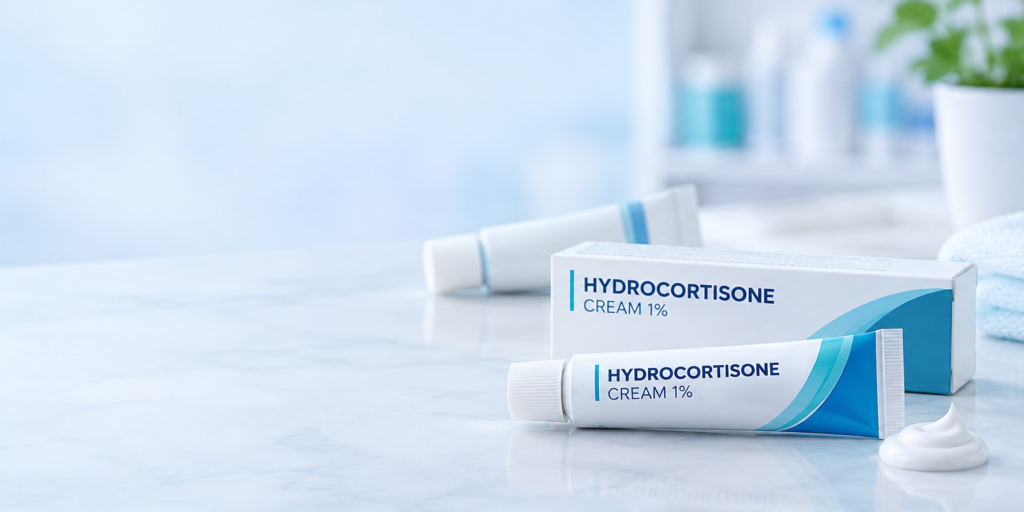
Hydrocortisone 1% cream is the mildest class of topical steroid. It calms red, itchy, inflamed skin caused by mild eczema, contact dermatitis and insect bites.
It works best as a short course: a thin layer once or twice a day for up to 7 days. It does not treat skin infections, acne or the underlying cause of eczema.
In Malaysia, it is sold under several brands, including Xepacort 1% cream. This guide covers what it treats, how strong it really is, where not to use it, and how the local brands compare.
What is hydrocortisone 1% cream?
Hydrocortisone is a corticosteroid, a synthetic version of cortisol, a hormone the body makes naturally. “1%” means each gram of cream contains 10 mg of hydrocortisone.
Applied to the skin, it reduces the immune reaction that causes inflammation. Blood vessels narrow, swelling goes down, and the signals that drive redness and itch are dampened.
It comes as a cream for moist or weeping skin and as an ointment for dry, thickened skin. Both carry the same strength.
Is hydrocortisone a strong steroid?
No. Hydrocortisone 1% sits in the lowest of the four potency classes used by doctors and pharmacists. Stronger steroids are reserved for thicker skin and more severe flares, usually on prescription.
| Potency class | Example ingredients | Typical use |
|---|---|---|
| Mild | Hydrocortisone 0.5–1% | Mild eczema, insect bites, short courses; thin skin under medical advice |
| Moderate | Clobetasone butyrate 0.05% | Flares that do not settle on a mild steroid |
| Potent | Betamethasone valerate 0.1%, mometasone furoate 0.1% | Moderate to severe eczema and psoriasis on the body |
| Very potent | Clobetasol propionate 0.05% | Severe, stubborn patches; short courses under a doctor |
Because it is mild, hydrocortisone 1% has a lower risk of side effects than stronger steroids. That does not make it suitable for every rash, or for long-term daily use.
What is hydrocortisone cream used for?
Hydrocortisone 1% cream is used for mild, non-infected skin inflammation that causes redness and itch.
- Mild eczema (atopic dermatitis): dry, itchy patches on the arms, legs or body.
- Contact dermatitis: reactions to soaps, detergents, metals such as nickel, or plants.
- Insect bites and stings: mosquito, sandfly and ant bites that stay swollen and itchy.
- Heat rash irritation: itch from prickly heat once the skin is cool and dry.
- Mild allergic skin reactions: localised itch and redness without blistering or spreading.
It is not a treatment for fungal rashes such as ringworm or jock itch, bacterial infections, cold sores, chickenpox, acne or dandruff. Using it on these can make them worse.
Does hydrocortisone heal or just stop itching?
It does more than stop itching, but it does not cure the cause. Hydrocortisone treats the inflammation itself, which is why redness and swelling settle along with the itch.
Calming the itch also breaks the itch–scratch cycle. Less scratching gives damaged skin the chance to repair, so a flare often clears within a few days.
What it cannot do is remove the trigger. Eczema can return, and an allergen or irritant will cause a new reaction on the next contact. Daily moisturising and avoiding known triggers do the long-term work.
How to apply hydrocortisone 1% cream
Follow the product leaflet or your pharmacist’s directions. The general approach is:
- Wash and dry your hands and the affected skin.
- Squeeze out a small amount. One fingertip unit, a line of cream from the tip to the first crease of an adult finger, covers an area the size of two adult palms.
- Spread a thin layer over the affected area only, and rub in gently.
- Apply once or twice a day. More often does not work better.
- Wash your hands afterwards, unless you are treating your hands.
- If you also use a moisturiser, apply it first and wait about 30 minutes before the cream.
Without a doctor’s advice, stop after 7 days. If the skin has not improved, or gets worse, speak to a pharmacist or doctor.
Where should you not apply hydrocortisone?
Do not apply hydrocortisone 1% cream to these areas without a doctor’s advice:
- Eyes and eyelids: steroid near the eye can raise eye pressure.
- Face: facial skin is thin and prone to thinning, acne-like rashes and rosacea flares.
- Groin, genitals and around the anus: thin skin absorbs more steroid.
- Broken, cut or infected skin: including weeping, crusted or pus-filled areas.
- Under nappies or tight dressings: covering the skin increases absorption.
Check with a doctor or pharmacist first if you are pregnant or breastfeeding, or if the cream is for a child under 10.
Side effects
Used as directed for a short course, side effects are uncommon. The most likely is brief stinging or burning when the cream first goes on.
Longer or heavier use than recommended raises the risk of:
- Thinning of the skin, which may bruise or tear easily
- Stretch marks or visible small blood vessels
- Lighter or darker patches of skin
- Worsening of an untreated fungal or bacterial infection
Stop using the cream and seek advice if the rash spreads, blisters, oozes or does not improve within 7 days.
Xepacort vs other hydrocortisone creams in Malaysia
All plain hydrocortisone 1% creams contain the same active ingredient at the same strength. The differences are the base, the pack size and the price, not how well they work.
Combination creams are a different category. They add an antifungal or antibiotic and are meant for inflamed skin that is also infected, usually after a doctor’s assessment.
| Product | Active ingredients | Type | Pack size | DOC price (RM) |
|---|---|---|---|---|
| Xepacort 1% cream (Xepa-Soul Pattinson) | Hydrocortisone 1% | Plain mild steroid | XX |
Which to choose: for a simple itchy rash or bite, any plain hydrocortisone 1% cream is suitable, so choose on price and pack size. If the rash may be fungal or infected, do not self-treat with a combination cream; ask a pharmacist or doctor first.
Production note: fill brands and prices from the live DOC catalogue on the publish date, and confirm Daktacort and Fucidin H are stocked before keeping those rows.
When to see a doctor
Speak to a doctor rather than continuing to self-treat if:
- The rash has not improved after 7 days of use
- It is spreading, blistering, oozing, crusting or painful
- You have a fever or feel unwell alongside the rash
- The rash is on the face, eyes or genitals
- The rash keeps coming back after each course
- The cream is for a baby or young child
Not sure if hydrocortisone is right for your rash? Consult a DoctorOnCall doctor online, share a photo of the affected skin, and get treatment delivered to your door.
Already know what you need? Order Xepacort 1% cream from the DoctorOnCall pharmacy.
Frequently asked questions
Is hydrocortisone a strong steroid?
No. Hydrocortisone 1% is in the mild class, the lowest of the four potency levels. It is used for mild inflammation and short courses.
Where should you not apply hydrocortisone?
Avoid the eyes, face, groin and genitals, and broken or infected skin, unless a doctor advises otherwise. Do not cover treated skin with tight dressings or nappies.
Does hydrocortisone heal or just stop itching?
It reduces the inflammation behind the itch, so redness and swelling improve too. It does not cure eczema or remove the trigger, so flares can return.
How long can I use hydrocortisone 1% cream?
Without medical advice, up to 7 days. Longer use should be guided by a doctor.
Can I use hydrocortisone cream on my face?
Only if a doctor recommends it. Facial skin is thin and more prone to side effects.
Can hydrocortisone cream treat fungal infections?
No. It can make fungal rashes such as ringworm worse. These need an antifungal cream.
Is Xepacort the same as other hydrocortisone creams?
Xepacort 1% contains the same active ingredient at the same strength as other plain hydrocortisone 1% creams. The main differences are the base, pack size and price.
Can I use hydrocortisone cream on my child?
Ask a doctor or pharmacist before using it on a child under 10.
Eczema Cream in Malaysia: When Xepacort (Hydrocortisone) Helps – Face, Baby & Body
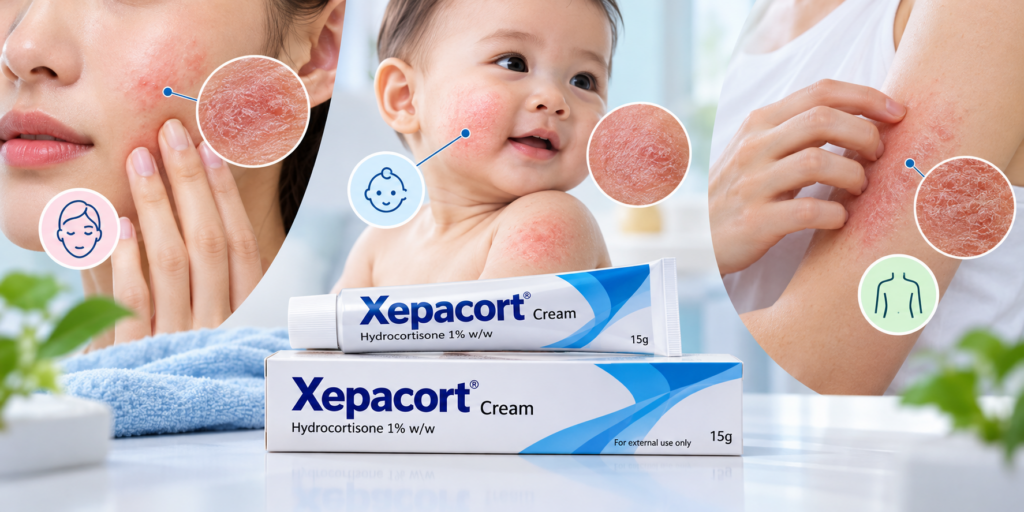
The right eczema cream depends on what your skin is doing today. A fragrance-free moisturiser is the daily foundation for every type of eczema. When skin turns red, inflamed and intensely itchy despite moisturising, a short course of a mild steroid such as hydrocortisone 1% (Xepacort) is often the next step.
Most eczema cream advice in Malaysia stops at moisturiser recommendations. This guide covers the step most people are unsure about: when hydrocortisone is appropriate, how to use it on the face, body and in children, and when a doctor should take over.
Why moisturiser comes first
Eczema (atopic dermatitis) is a weakened skin barrier that loses water and lets irritants in. The result is dry, itchy skin that flares in cycles. In Malaysia, heat, sweat, humidity, harsh soaps and long hot showers are common triggers.
A moisturiser, also called an emollient, repairs that barrier. It does not reduce active inflammation, but used daily it lowers how often flares happen and how severe they get.
How to get the most from it:
- Apply generously at least twice a day, and within three minutes of bathing while skin is still damp.
- Choose fragrance-free products. Ointments are the most protective, creams suit daytime, and lotions are lightest but least effective for very dry skin.
- Keep moisturising during and after a flare, not only when skin looks dry.
- Replace regular soap with a soap-free wash or emollient cleanser.
When hydrocortisone 1% is the right step
Hydrocortisone 1% is the mildest strength of topical corticosteroid. It calms inflammation, redness and itch during a flare, which moisturiser alone cannot do. Xepacort Cream contains hydrocortisone 1%.
It is usually appropriate when all of the following apply:
- The patch is red, inflamed and itchy, not just dry or rough.
- Moisturising regularly for several days has not settled it.
- The flare is small to moderate in size, not widespread.
- The skin is unbroken, with no weeping, crusting or pus.
- The area has previously been confirmed as eczema by a doctor, or a pharmacist has assessed it.
Hydrocortisone is a short-term flare treatment, not a daily cream. Once the flare settles, return to moisturiser alone.
Do not use it on skin that may be infected, on fungal rashes such as ringworm or tinea, on acne, rosacea or cold sores, or in or around the eyes. A steroid can make these conditions worse.
Moisturiser vs hydrocortisone: which do you need
Most people with Eczema need both, used for different jobs.
| Moisturiser (emollient) | Hydrocortisone 1% (e.g. Xepacort) | |
|---|---|---|
| What it does | Repairs and protects the skin barrier | Reduces inflammation, redness and itch |
| When to use | Every day, flare or no flare | During a flare only |
| How long | Ongoing | Short course, usually up to 7 days without medical advice |
| How much | Generously | A thin layer on affected skin only |
| Face | Yes | Short courses, with pharmacist or doctor advice |
| Babies and children | Yes, from birth | On a doctor’s advice |
| Broken or infected skin | Gentle use only | No |
How to use Xepacort correctly
Used thinly, briefly and only where needed, hydrocortisone 1% has a low risk of side effects. Always follow the pack leaflet or your pharmacist’s instructions.
- Wash and dry your hands, then the affected area.
- Squeeze a line of cream from your fingertip to the first finger crease. This fingertip unit covers an area about the size of two adult palms.
- Spread a thin layer over the inflamed patch only, once or twice a day.
- Wait about 20 to 30 minutes before applying moisturiser on the same area, so the two do not dilute each other. Moisturise all other dry skin as usual.
- Stop once the skin has settled. If there is no clear improvement after 7 days, stop and speak to a doctor.
Avoid covering treated skin with tight dressings or plastic unless a doctor advises it, as this increases how much steroid is absorbed.
Can you use hydrocortisone on the face
Yes, for short periods and with professional advice first. Facial skin is thinner and absorbs steroids more readily, so doctors choose the mildest strength, hydrocortisone 1%, when the face needs one.
- Confirm it is eczema. Facial rashes are often rosacea, acne, perioral dermatitis or a fungal infection, and a steroid can worsen all of these.
- Keep courses short, typically a few days, and stop as soon as the redness settles.
- Keep it away from the eyes and eyelids unless a doctor specifically advises it.
- Never use a stronger steroid cream on the face unless it is prescribed for that purpose.
Long-term facial steroid use can cause skin thinning, visible blood vessels and a rebound rash when stopped. If facial eczema keeps returning, a doctor can discuss steroid-free alternatives.
Is hydrocortisone safe for babies and children
Hydrocortisone 1% is one of the steroids doctors most often prescribe for baby and child eczema, but it should be started on a doctor’s advice, not self-selected. A baby’s skin absorbs more medicine relative to body size, and infant rashes have many causes besides eczema.
For babies and young children:
- Moisturise from head to toe at least twice a day with a fragrance-free emollient. This is the main treatment.
- See a doctor before using any steroid cream, and follow the exact area, amount and number of days they give.
- Do not use it in the nappy area unless a doctor advises it. The nappy acts like a cover and increases absorption.
- Use a fingertip unit as a guide and apply a thin layer only.
Used as directed, mild steroids are safe and effective for children. Under-treating a flare out of worry often leads to more itching, broken skin and infection. If you are concerned, ask the doctor to explain the plan rather than stopping on your own.
Body, hands and skin folds
On the body, hydrocortisone 1% suits mild flares on the arms, legs, inner elbows, behind the knees and the neck. How well it works depends on skin thickness.
| Area | What to expect |
|---|---|
| Inner elbows, behind knees, neck | Usually responds well to a short course |
| Armpits, groin, under the breasts | Thin skin that absorbs more. Use briefly, and check for fungal infection first, as these warm, sweaty folds are prone to it in Malaysia’s climate |
| Hands and feet | Thick skin, so a mild steroid may not be strong enough. See a doctor if there is no improvement in 7 days |
| Large areas of the body | Not for self-treatment. See a doctor |
For hand eczema, reapply moisturiser after every hand wash and wear gloves for wet work and cleaning products.
When to see a doctor
See a doctor rather than self-treating if any of the following apply:
- No clear improvement after 7 days of hydrocortisone 1%.
- The rash is spreading or covers a large area.
- The skin is weeping, crusting, oozing yellow fluid or very painful, which can signal infection.
- Your baby is under one year old, or this is a child’s first rash.
- Flares return within weeks of stopping treatment.
- Itching is disturbing sleep, work or school.
- You are unsure whether the rash is eczema.
Seek urgent care the same day for painful clusters of blisters or small punched-out sores on eczema skin, especially with fever. This can be eczema herpeticum, a viral infection that needs prompt treatment.
A doctor can confirm the diagnosis, prescribe a stronger or steroid-free treatment where needed, and give you a written flare plan.
Frequently asked questions
What is the best eczema cream in Malaysia?
There is no single best cream. A fragrance-free moisturiser suits daily care for everyone, and a mild steroid such as hydrocortisone 1% suits short-term flare control. The best choice depends on the flare, the area and the person’s age.
Is Xepacort a steroid?
Yes. Xepacort contains hydrocortisone 1%, the mildest strength of topical corticosteroid.
Can I use Xepacort on my face?
Only for a few days at a time, away from the eyes, and after a pharmacist or doctor has confirmed the rash is eczema.
Can I use Xepacort on my baby?
Speak to a doctor first. Hydrocortisone 1% is commonly prescribed for infant eczema, but the area, amount and duration should be set by a doctor.
How long can I use hydrocortisone cream?
Without medical advice, generally up to 7 days. Stop sooner if the skin clears, and see a doctor if it has not improved.
Should I apply moisturiser or hydrocortisone first?
Either order works. Leave about 20 to 30 minutes between them on the same area.
Does hydrocortisone cure eczema?
No. It controls flares. Daily moisturising and avoiding triggers are what keep eczema under control over time.
Manage eczema with DoctorOnCall
Effective eczema care has two parts: a moisturiser every day and the right flare treatment when skin becomes inflamed.
- Daily barrier care: browse fragrance-free emollients and soap-free washes in the DOC eczema and dry skin range.
- Flare control: Xepacort Cream (hydrocortisone 1%) is available from DoctorOnCall’s online pharmacy, with pharmacist guidance on safe use.
- Not sure it is eczema, or treating a baby or the face? Consult a doctor online for a diagnosis and a treatment plan, with medicines delivered to your door.
Xepacort Cream: What It’s Used For, How to Apply & Price
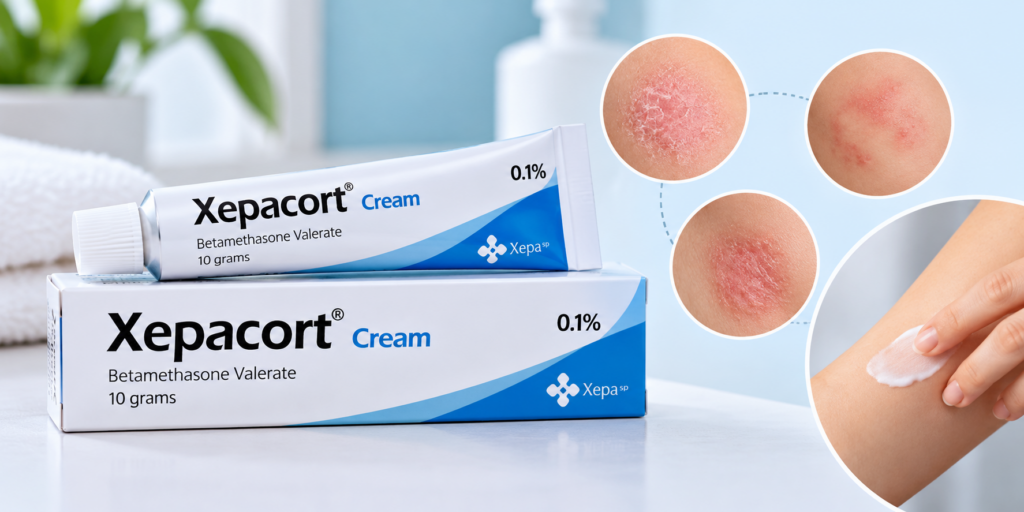
What is Xepacort Cream?
Xepacort Cream contains hydrocortisone 1% w/w, a corticosteroid that calms inflammation in the skin. It is made in Malaysia by Xepa-Soul Pattinson and is commonly sold in a 15 g tube.
Hydrocortisone works by reducing the skin’s immune response at the site of application. This eases itch, redness and swelling, but it does not treat the underlying cause, such as an allergen, an irritant or an infection.
| Detail | Xepacort Cream |
|---|---|
| Active ingredient | Hydrocortisone 1% w/w |
| Drug class | Topical corticosteroid (mild potency) |
| Form | Cream |
| Manufacturer | Xepa-Soul Pattinson (Malaysia) |
| Common pack size | 15 g tube (confirm against product page) |
What is Xepacort Cream used for?
Xepacort Cream is used to relieve inflammation and itching in mild, non-infected skin conditions that respond to a steroid. It is suited to small areas and short courses.
Common uses include:
- Eczema (atopic dermatitis): mild flare-ups with dry, itchy, red patches
- Contact dermatitis: reactions to irritants or allergens such as detergents, metals, cosmetics or plants
- Insect bites and stings: localised itch and swelling
- Heat rash and mild skin allergies: itchy, inflamed rashes without broken skin
- Seborrhoeic dermatitis: mild red, flaky patches, on a doctor’s or pharmacist’s advice
Xepacort does not treat fungal infections (ringworm, athlete’s foot, jock itch), bacterial infections, cold sores, chickenpox or acne. Using a steroid on these can make them worse.
Is hydrocortisone a strong steroid?
No. Hydrocortisone 1% is classed as a mild topical steroid, the lowest of the four potency groups. That is why it can be used for short periods on sensitive areas under advice, where stronger steroids are not recommended.
| Potency | Example ingredients | Typical use |
|---|---|---|
| Mild | Hydrocortisone 1% (Xepacort) | Mild eczema, bites, rashes; children and sensitive areas with advice |
| Moderate | Clobetasone butyrate 0.05% | Moderate eczema not controlled by a mild steroid |
| Potent | Betamethasone valerate 0.1%, mometasone 0.1% | Stubborn eczema, psoriasis on the body |
| Very potent | Clobetasol propionate 0.05% | Severe, thick or resistant skin conditions, specialist-led |
Mild does not mean risk-free. Long or heavy use on large areas, thin skin or under a covering can still cause side effects.
How to apply Xepacort Cream
Apply a thin layer to the affected skin once or twice a day, or as directed on the label or by your pharmacist. More cream does not work faster and raises the risk of side effects.
- Wash and dry your hands.
- Gently clean the affected area and pat it dry.
- Squeeze out a small amount. One fingertip unit, a line of cream from the tip to the first crease of an adult index finger, covers an area about the size of two adult palms.
- Spread it thinly over the affected skin and rub in gently until it disappears.
- Wash your hands afterwards, unless your hands are the area being treated.
- Do not cover the area with a bandage or plastic dressing unless a doctor tells you to.
If you also use a moisturiser, apply it first and wait about 15 to 30 minutes before applying Xepacort, or follow your pharmacist’s advice on timing.
How long can you use Xepacort Cream?
For self-treatment, use Xepacort for no longer than 7 days. If the skin has not improved within this time, or gets worse, stop and speak to a doctor.
Once symptoms clear, stop applying it. A doctor may advise a longer or repeated course for conditions such as eczema, with a plan to reduce use gradually. Avoid restarting long courses without medical review.
Precautions and side effects
Xepacort is well tolerated when used thinly and for short periods. Most problems come from using it too long, on the wrong condition or on thin skin.
Do not apply Xepacort:
- On broken, weeping or infected skin
- On fungal, bacterial or viral rashes, including cold sores and chickenpox
- On acne, rosacea or the rash around the mouth (perioral dermatitis)
- In or near the eyes
- On the face, groin or underarms for more than a few days unless a doctor advises it
Check with a doctor or pharmacist first if:
- It is for a child under 10, or for a baby’s nappy area
- You are pregnant or breastfeeding (do not apply to the nipple area)
- You are allergic to hydrocortisone or any ingredient in the cream
- You are already using another steroid cream or tablet
Possible side effects include a mild burning or stinging feeling when first applied. Prolonged or heavy use can cause thinning of the skin, stretch marks, visible small blood vessels, lighter skin patches or worsening of an untreated infection. Stop using the cream and seek advice if irritation increases or new symptoms appear.
Xepacort Cream price in Malaysia
Xepacort Cream 15 g is priced at RM [XX.XX] on DoctorOnCall [confirm live price before publishing]. Prices at other pharmacies vary by outlet and pack size.
Ordering on DoctorOnCall gives you:
- Genuine stock dispensed by licensed pharmacists
- Doorstep delivery across Malaysia
- Pharmacist support if you have questions about use
Buy Xepacort Cream on DoctorOnCall
Speak to a doctor if your skin does not improve after 7 days, keeps coming back, or shows signs of infection such as pus, crusting, spreading redness, warmth or fever. You should also seek advice if the rash covers a large area, affects the face or genitals, or occurs in a young child.
A doctor can confirm the cause and recommend a different strength or treatment if needed. You can speak to a Malaysian-registered doctor online through DoctorOnCall without leaving home.
Frequently asked questions
Can I use Xepacort Cream on my face?
Only for a few days and only on a doctor’s or pharmacist’s advice. Facial skin is thin and more prone to steroid side effects. Keep it away from the eyes.
Can Xepacort be used on babies and children?
Children under 10 should only use it on medical advice. Use the smallest amount for the shortest time, and do not cover the area with a tight nappy or dressing.
Is Xepacort an antifungal cream?
No. Xepacort contains only hydrocortisone and does not treat fungal infections. Using it alone on ringworm or other fungal rashes can make them spread.
Can I use Xepacort for insect bites?
Yes. A thin layer once or twice a day can ease the itch and swelling from mosquito and other insect bites.
Do I need a prescription to buy Xepacort Cream?
Xepacort is a pharmacy medicine in Malaysia [confirm classification with pharmacist]. It can be ordered on DoctorOnCall and is dispensed by licensed pharmacists.
What should I do if I forget to apply it?
Apply it when you remember, unless it is nearly time for the next application. Do not apply extra to make up for a missed dose.