
Scabies Treatment in Malaysia: Lotions, Creams & How to Stop It Coming Back
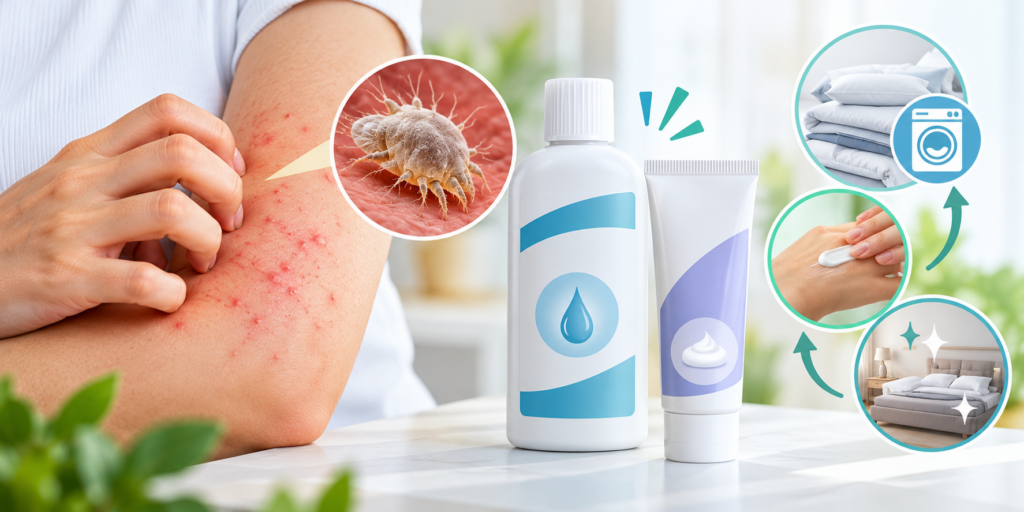
Scabies is treated with a prescription-strength cream or lotion applied from the neck down, usually permethrin 5% cream, with a second application 7 days later. Treatment only works when everyone in close contact is treated at the same time and bedding, towels and clothing are washed on the same day.
Most repeat cases are not treatment failure. They come from reinfection by an untreated family member, missed areas of skin, or items that were not washed. This guide covers the treatment options available in Malaysia, how to apply them correctly, and the steps that prevent scabies from returning.
In short
- First-line treatment: permethrin 5% cream, applied to the whole body and washed off after 8 to 14 hours
- Repeat the application after 7 days
- Treat all household members and close contacts on the same day, even without symptoms
- Wash bedding, towels and clothes used in the past 3 days at 60°C, or seal them in a bag for at least 72 hours
- Itching can continue for 2 to 4 weeks after successful treatment
What scabies is and how it spreads
Scabies is a skin infestation caused by a mite, Sarcoptes scabiei, which burrows into the top layer of skin to lay eggs. The intense itch, usually worse at night, is an allergic reaction to the mites and their waste. In a first infection, symptoms take 2 to 6 weeks to appear, so a person can spread scabies before they know they have it.
Common areas include the webs between fingers, wrists, elbows, armpits, waistline, buttocks and genitals. Look for small raised bumps, short grey or wavy lines (burrows) and scratch marks.
Scabies spreads mainly through prolonged skin-to-skin contact, which is why it moves easily within households, hostels, childcare centres and care homes. Sharing bedding, towels or clothing can also spread it, though less often. Scabies is not a sign of poor hygiene.
Scabies treatment options in Malaysia
Permethrin 5% cream is the first-line treatment in Malaysian and international guidelines for adults and children from 2 months of age. Other options are used when permethrin is unsuitable, unavailable or has not worked.
| Treatment | Form | Typical use | Notes |
|---|---|---|---|
| Permethrin 5% | Cream | First-line for adults and children from 2 months | Left on for 8 to 14 hours, repeated after 7 days. Generally well tolerated. |
| Benzyl benzoate 25% | Emulsion or lotion | Alternative when permethrin is unavailable | Can sting or burn on application. Diluted for children; not usually used for infants. |
| Sulphur 5–10% | Ointment | Sometimes used for infants and in pregnancy | Applied on several consecutive nights. Messy and has a strong odour. |
| Crotamiton 10% | Cream or lotion | Second-line option; also eases itch | Lower success rate than permethrin. |
| Oral ivermectin | Tablet, prescription only | Crusted scabies, outbreaks, or when creams fail | Prescribed and supervised by a doctor. Not for young children or pregnant women. |
Antihistamines and a mild steroid cream may be added to relieve itching, but they do not kill mites. Over-the-counter anti-itch creams, antiseptic soaps and home remedies such as tea tree oil or neem are not substitutes for an anti-scabies treatment.
DoctorOnCall stocks A-Scabs and permethrin 5% cream, delivered nationwide. Our pharmacists can advise on which product suits your household, including children and pregnant family members.
How to apply scabies cream or lotion correctly
Missed skin is one of the most common reasons treatment fails. Follow the instructions on your product label and these general steps.
- Apply at night, on cool, dry skin. If you shower first, wait until your skin has cooled down.
- Cover the whole body from the jawline down, including between fingers and toes, under the nails, the soles of the feet, the groin, genitals and the skin between the buttocks.
- For infants, young children, the elderly and people with weakened immunity, also apply to the scalp, face and ears, avoiding the eyes and mouth.
- Trim fingernails and work the cream underneath them, as mites collect there from scratching.
- Reapply to your hands each time you wash them during the treatment period.
- Leave the product on for the time stated on the label, usually 8 to 14 hours for permethrin, then wash it off.
- Change into clean clothes and use fresh bedding after washing off.
- Repeat the full application 7 days later to kill mites that have hatched since the first treatment.
An adult typically needs one 30 g tube of permethrin cream per full-body application. Check the product label for amounts for children.
Treat the whole household on the same day
Everyone who lives with you or has had close skin contact with you in the past 6 weeks should be treated at the same time, even if they have no itch or rash. Symptoms take weeks to appear, so a family member without symptoms can still carry mites and reinfect everyone else.
- Treat household members, partners and anyone who regularly shares a bed, such as a grandparent or domestic helper
- Apply both rounds on the same nights for everyone
- Inform your child’s school, nursery or babysitter so close contacts can be checked
- Children can usually return to school the day after the first treatment
Pregnant or breastfeeding women, babies under 2 months and anyone with a skin condition such as eczema should speak to a doctor or pharmacist before using any scabies treatment.
Clothes, bedding and laundry
Scabies mites usually survive 2 to 3 days away from human skin. Items used in the 3 days before treatment need to be cleaned or isolated on the day of the first application.
| Item | What to do |
|---|---|
| Bedsheets, pillowcases, towels, clothes, underwear | Wash at 60°C or higher, then dry on a hot cycle or in direct sun |
| Items that cannot be washed hot (soft toys, shoes, jackets, cushions) | Seal in a plastic bag for at least 72 hours |
| Mattresses, sofas, car seats | Vacuum thoroughly and dispose of the vacuum bag or empty the canister outside |
Fumigating the house or spraying insecticides on furniture is not necessary for ordinary scabies. For crusted scabies, which carries far more mites, a doctor may advise more thorough cleaning of the home.
How to tell if scabies is going away
Itching that continues for 2 to 4 weeks after treatment is normal and does not mean the treatment has failed. The skin is still reacting to dead mites and their debris.
Signs treatment is working:
- No new bumps, blisters or burrows appearing after the second application
- Itching gradually becoming less intense, especially at night
- Existing spots flattening and healing
Signs to see a doctor:
- New burrows or spots appearing more than 2 weeks after the second application
- Itching getting worse, not better, after 4 weeks
- Spots that become painful, swollen, crusted or filled with pus
Why scabies comes back
Most cases that return are reinfection or incomplete treatment, not resistance to the cream. Check each point below before starting another course.
| Common cause | How to prevent it |
|---|---|
| A household member or partner was not treated | Treat every close contact on the same nights, with or without symptoms |
| The second application was skipped | Repeat the full application exactly 7 days after the first |
| Areas of skin were missed | Cover hands, between fingers, under nails, feet, groin and genitals; reapply after handwashing |
| Product washed off too early | Keep it on for the full time stated on the label |
| Bedding and clothes not cleaned | Wash at 60°C or bag for 72 hours on the day of the first treatment |
| Contact with an untreated person outside the home | Inform school, workplace or care home contacts so they can be checked |
If scabies returns after two correctly completed courses, see a doctor. You may need a different treatment, such as oral ivermectin, or a review to confirm the diagnosis.
When to see a doctor
Many people can manage scabies with a pharmacist’s advice, but some situations need a doctor’s assessment first.
- You are not sure the rash is scabies. Eczema, insect bites and other skin conditions can look similar
- The patient is a baby under 2 months, or is pregnant or breastfeeding
- The skin has thick, grey, crusted patches, which may indicate crusted scabies
- Spots are infected: painful, hot, swollen, weeping or with pus, or there is fever
- The patient is elderly, bedbound or has a weakened immune system
- Symptoms have not improved 4 weeks after two correctly completed treatments
You can speak to a licensed Malaysian doctor through a DoctorOnCall online consultation. The doctor can review photos of the rash, advise on treatment for the whole household and arrange delivery of prescribed medication.
Frequently asked questions
What is the fastest way to kill scabies?
A correctly applied anti-scabies treatment, such as permethrin 5% cream, kills most mites within one application of 8 to 14 hours. A second application after 7 days is still needed to kill newly hatched mites. Treating all close contacts and washing bedding on the same day prevents reinfection.
How long can scabies live on clothes?
Scabies mites usually survive 2 to 3 days off the body at room temperature. Washing at 60°C or sealing items in a bag for 72 hours is enough to kill them.
How do I know if scabies is going away?
No new spots or burrows after the second treatment, and itching that slowly eases over 2 to 4 weeks, are signs it is clearing. New spots more than 2 weeks after treatment should be checked by a doctor.
Can I buy scabies cream without a prescription in Malaysia?
Some scabies creams and lotions are available from pharmacies after consultation with a pharmacist. Oral ivermectin requires a doctor’s prescription.
Is scabies contagious after treatment?
A person is generally no longer considered contagious 24 hours after the first full application. Continue the second application and laundry steps to complete treatment.
Can scabies go away on its own?
No. Without treatment, mites continue to reproduce and the infestation spreads to others.